偷 (tōu) means "To steal / Secretly" in Chinese. It has 11 strokes with the radical 亻, and is HSK Level 5.
Rated 3.9/5 in difficulty (challenging).
Harder than 43% of HSK Level 5 characters.
Appears in 3+ common words including 偷看 (tōu kàn), 偷懒 (tōu lǎn), 偷听 (tōu tīng).
Due to its 11 strokes, Hanzi Writer's error detection shows 偷 requires focused practice — most learners need 10+ attempts for consistent accuracy.
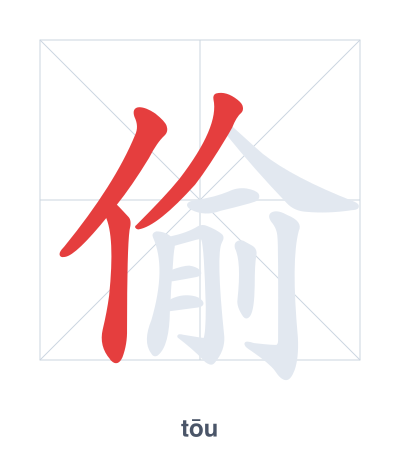
Open Hanzi Writer to see the animated stroke order and practice writing 偷 with real-time feedback.
The character 偷 (tōu) is written with 11 strokes. Follow the standard Chinese stroke order: top to bottom, left to right, outside before inside. The radical 亻 is one of its key components.
Practice the correct stroke order with the Hanzi Writer app to see animated stroke-by-stroke guidance with real-time feedback.
偷 means To steal / Secretly.
As an HSK Level 5 character, 偷 is an intermediate-level character.
偷 is a phono-semantic compound with the radical 亻 (person) indicating a human action, and the component 俞 (yú) providing the pronunciation. The meaning 'to steal' comes from the idea of a person acting secretly or taking something without permission.
💡 Memory Tip: Picture a thief (亻) sneaking up to a person (top of 俞) who is cutting meat (月) with a knife (刂) and stealing the meat.
别偷看我的手机。
bié tōu kàn wǒ de shǒu jī
Don't snoop on my phone.
他经常在工作时偷懒。
tā jīng cháng zài gōng zuò shí tōu lǎn
He often slacks off at work.
偷听别人说话是不对的。
tōu tīng bié rén shuō huà shì bú duì de
It is wrong to eavesdrop on others.
Open Hanzi Writer to see the animated stroke order and practice writing 偷 with real-time feedback.
✨ Animated stroke order · Handwriting recognition · HSK-graded practice · Free to use
偷 is made of the radical 亻 (person) on the left and the component 俞 (yú) on the right. The person radical suggests the action is done by a person, while 俞 contributes the sound and implies the idea of moving secretly like a boat slipping away, together forming the meaning of stealing or doing something secretly.