仇 (chóu/qiú) means "Enemy or hatred" in Chinese. It has 4 strokes with the radical 亻, and is HSK Level 7.
Rated 2.4/5 in difficulty (moderate).
Harder than 2% of HSK Level 7 characters.
Appears in 4+ common words including 仇人 (chóu rén), 报仇 (bào chóu), 仇恨 (chóu hèn).
Hanzi Writer's stroke validation shows learners typically need 5-8 attempts to write 仇 with correct proportion and order.
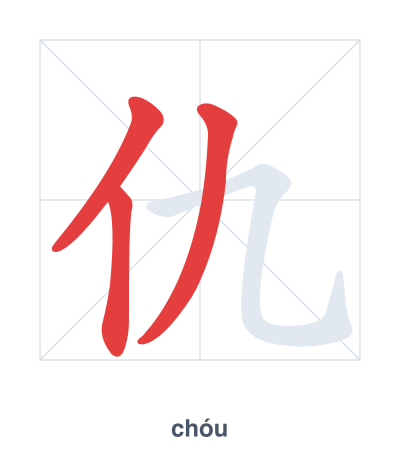
Open Hanzi Writer to see the animated stroke order and practice writing 仇 with real-time feedback.
The character 仇 (chóu/qiú) is written with 4 strokes. Follow the standard Chinese stroke order: top to bottom, left to right, outside before inside. The radical 亻 is one of its key components.
Practice the correct stroke order with the Hanzi Writer app to see animated stroke-by-stroke guidance with real-time feedback.
仇 means Enemy or hatred.
This is a polyphonic character with readings: chóu, qiú.
As an HSK Level 7 character, 仇 is an intermediate-level character.
仇 is a compound character with the radical 亻 (person) and the component 九 (nine). Originally it meant a 'mate' or 'pair,' but later shifted to mean 'enemy' or 'hatred,' possibly because a rival was seen as an equal opponent. The nine may hint at the idea of 'many' or 'contending' as in facing a multitude of foes.
💡 Memory Tip: Picture a person (亻) surrounded by nine (九) enemies all glaring with hatred.
他是我的仇人。
tā shì wǒ de chóu rén
He is my enemy.
他想为朋友报仇。
tā xiǎng wèi péng yǒu bào chóu
He wants to avenge his friend.
我们不要有仇恨。
wǒ men bú yào yǒu chóu hèn
We shouldn't hold onto hatred.
这个人姓仇。
zhè gè rén xìng qiú
This person's surname is Qiu.
Open Hanzi Writer to see the animated stroke order and practice writing 仇 with real-time feedback.
✨ Animated stroke order · Handwriting recognition · HSK-graded practice · Free to use
仇 is made of two parts: the left radical 亻 (person) and the right component 九 (nine). Together they suggest a person who has many conflicts, because 九 can imply a large number, leading to the meanings of enemy or hatred.