听 (tīng) means "to listen, to hear" in Chinese. It has 7 strokes with the radical 口, and is HSK Level 1.
Rated 2.9/5 in difficulty (moderate).
Harder than 52% of HSK Level 1 characters.
Appears in 3+ common words including 听见 (tīng jiàn), 听音乐 (tīng yīn yuè), 听说 (tīng shuō).
Hanzi Writer's stroke validation shows learners typically need 5-8 attempts to write 听 with correct proportion and order.
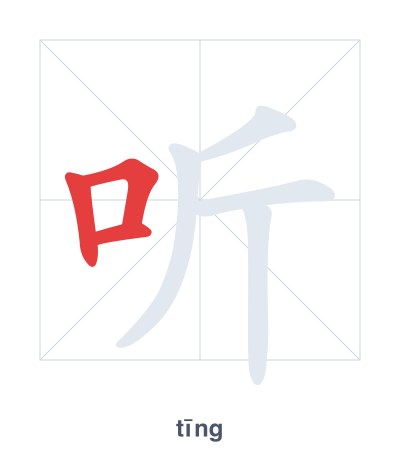
Open Hanzi Writer to see the animated stroke order and practice writing 听 with real-time feedback.
The character 听 (tīng) is written with 7 strokes. Follow the standard Chinese stroke order: top to bottom, left to right, outside before inside. The radical 口 is one of its key components.
Practice the correct stroke order with the Hanzi Writer app to see animated stroke-by-stroke guidance with real-time feedback.
听 means to listen, to hear.
As an HSK Level 1 character, 听 is among the first characters beginners learn.
听 originally combined the mouth radical (口) with 斤, an axe that also represented a laughing sound. In simplified Chinese, this character replaced the traditional 聽 (ear + virtue + heart) to mean 'to listen', though its visual form no longer directly shows an ear.
💡 Memory Tip: Picture opening your mouth (口) like a wide axe blade (斤) to catch every sound in the air.
你听见我说话了吗?
nǐ tīng jiàn wǒ shuō huà le ma
Did you hear what I said?
我喜欢听音乐。
wǒ xǐ huān tīng yīn yuè
I like listening to music.
我听说他生病了。
wǒ tīng shuō tā shēng bìng le
I heard that he is sick.
Open Hanzi Writer to see the animated stroke order and practice writing 听 with real-time feedback.
✨ Animated stroke order · Handwriting recognition · HSK-graded practice · Free to use
听 is made of two parts: the left radical 口 (mouth) and the right part 斤 (a phonetic component). The mouth radical hints that the character relates to sound or speech, while 斤 gives the pronunciation tīng. Together, they form the meaning 'to listen' or 'to hear'.