仂 (lè) means "Remainder or fraction" in Chinese. It has 4 strokes with the radical 亻.
Rated 2.4/5 in difficulty (moderate).
Appears in 3+ common words including 仂语 (lè yǔ), 馀仂 (yú lè), 仂数 (lè shù).
Hanzi Writer's stroke validation shows learners typically need 5-8 attempts to write 仂 with correct proportion and order.
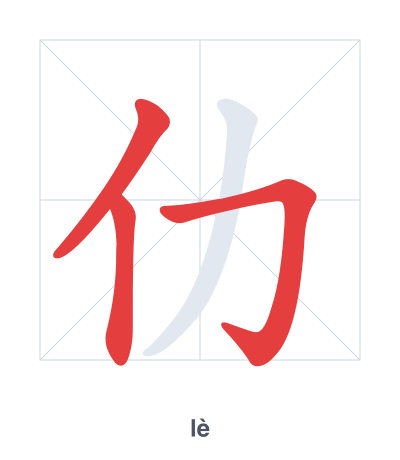
Open Hanzi Writer to see the animated stroke order and practice writing 仂 with real-time feedback.
The character 仂 (lè) is written with 4 strokes. Follow the standard Chinese stroke order: top to bottom, left to right, outside before inside. The radical 亻 is one of its key components.
Practice the correct stroke order with the Hanzi Writer app to see animated stroke-by-stroke guidance with real-time feedback.
仂 means Remainder or fraction.
The character 仂 combines the person radical 亻 with 力 (strength/power). It originally meant a small leftover portion or fraction, possibly referring to the remaining strength of a person after exertion. Structurally, it suggests a person's limited or residual share of effort.
💡 Memory Tip: Imagine a person (亻) who has only a fraction of their strength (力) left—the remainder after hard work.
这是一个常用的仂语。
zhè shì yí gè cháng yòng de lè yǔ
This is a commonly used phrase.
这里的馀仂并不多。
zhè lǐ de yú lè bìng bù duō
There isn't much surplus energy here.
请计算这个仂数。
qǐng jì suàn zhè ge lè shù
Please calculate this fractional part.
Open Hanzi Writer to see the animated stroke order and practice writing 仂 with real-time feedback.
✨ Animated stroke order · Handwriting recognition · HSK-graded practice · Free to use
The character 仂 consists of the radical 亻 (person) on the left and 力 (strength) on the right. The right part 力 gives a clue to the pronunciation (lè, close to lì). The meaning "remainder" or "fraction" is not directly from the components, so the character is mostly phonetic with the person radical acting as a classifier.