仍 (réng) means "Still; yet." in Chinese. It has 4 strokes with the radical 亻, and is HSK Level 3.
Rated 2.4/5 in difficulty (moderate).
Harder than 5% of HSK Level 3 characters.
Appears in 3+ common words including 仍然 (réng rán), 仍旧 (réng jiù), 仍需 (réng xū).
Hanzi Writer's stroke validation shows learners typically need 5-8 attempts to write 仍 with correct proportion and order.
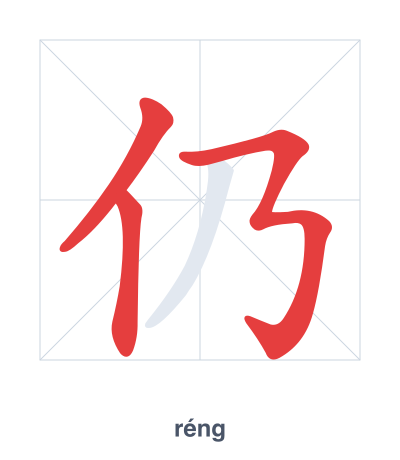
Open Hanzi Writer to see the animated stroke order and practice writing 仍 with real-time feedback.
The character 仍 (réng) is written with 4 strokes. Follow the standard Chinese stroke order: top to bottom, left to right, outside before inside. The radical 亻 is one of its key components.
Practice the correct stroke order with the Hanzi Writer app to see animated stroke-by-stroke guidance with real-time feedback.
仍 means Still; yet..
As an HSK Level 3 character, 仍 is an intermediate-level character.
This character combines the person radical 亻 with 乃 (nǎi), which originally depicted a curved line representing 'then' or 'to be.' Together, they suggest a person persisting in a state, hence the meaning 'still' or 'yet.'
💡 Memory Tip: Imagine a person (亻) who is still (仍) bending over (like the curved shape of 乃) because they have not yet finished their work.
他仍然住在北京。
tā réng rán zhù zài běi jīng
He still lives in Beijing.
这里的环境仍旧没变。
zhè lǐ de huán jìng réng jiù méi biàn
The environment here remains unchanged.
我们仍需继续努力。
wǒ men réng xū jì xù nǔ lì
We still need to keep working hard.
Open Hanzi Writer to see the animated stroke order and practice writing 仍 with real-time feedback.
✨ Animated stroke order · Handwriting recognition · HSK-graded practice · Free to use
仍 consists of the radical 亻 (person) on the left and 乃 (nai, meaning "thus" or "to be") on the right. The person radical indicates that the character relates to people or actions, while 乃 suggests continuity, together forming the idea of someone continuing an action—hence "still" or "yet."