仁 (rén) means "Benevolence or kindness" in Chinese. It has 4 strokes with the radical 亻, and is HSK Level 7.
Rated 2.4/5 in difficulty (moderate).
Harder than 1% of HSK Level 7 characters.
Appears in 3+ common words including 仁爱 (rén ài), 虾仁 (xiā rén), 同仁 (tóng rén).
Hanzi Writer's stroke validation shows learners typically need 5-8 attempts to write 仁 with correct proportion and order.
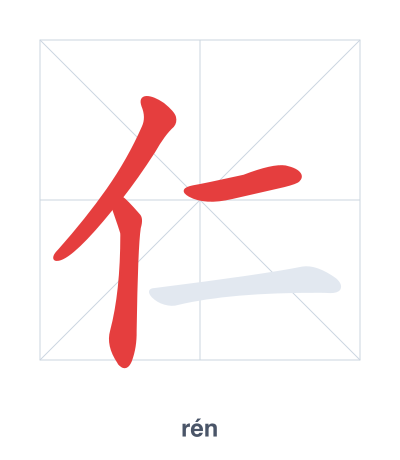
Open Hanzi Writer to see the animated stroke order and practice writing 仁 with real-time feedback.
The character 仁 (rén) is written with 4 strokes. Follow the standard Chinese stroke order: top to bottom, left to right, outside before inside. The radical 亻 is one of its key components.
Practice the correct stroke order with the Hanzi Writer app to see animated stroke-by-stroke guidance with real-time feedback.
仁 means Benevolence or kindness.
As an HSK Level 7 character, 仁 is an intermediate-level character.
仁 combines the person radical 亻 with the numeral 二 (two), suggesting that benevolence is the proper relationship between two people. In Confucian philosophy, it represents the core virtue of treating others with kindness and humanity.
💡 Memory Tip: Picture a person (亻) with two open arms (二) ready to embrace others in kindness.
他是一个仁爱的人。
tā shì yí gè rén ài de rén
He is a benevolent person.
我想吃虾仁饺子。
wǒ xiǎng chī xiā rén jiǎo zi
I want to eat shrimp dumplings.
各位同仁,大家好。
gè wèi tóng rén dà jiā hǎo
Hello, colleagues.
Open Hanzi Writer to see the animated stroke order and practice writing 仁 with real-time feedback.
✨ Animated stroke order · Handwriting recognition · HSK-graded practice · Free to use
仁 is made of the radical 亻 (person) on the left and the number 二 (two) on the right. Together they suggest "a person with another" — the idea of kindness and benevolence between people.