薯 (shǔ) means "Potato / Tuber" in Chinese. It has 16 strokes with the radical 艹, and is HSK Level 6.
Rated 4.2/5 in difficulty (advanced).
Harder than 88% of HSK Level 6 characters.
Appears in 3+ common words including 红薯 (hóng shǔ), 薯条 (shǔ tiáo), 马铃薯 (mǎ líng shǔ).
Due to its 16 strokes, Hanzi Writer's error detection shows 薯 requires focused practice — most learners need 10+ attempts for consistent accuracy.
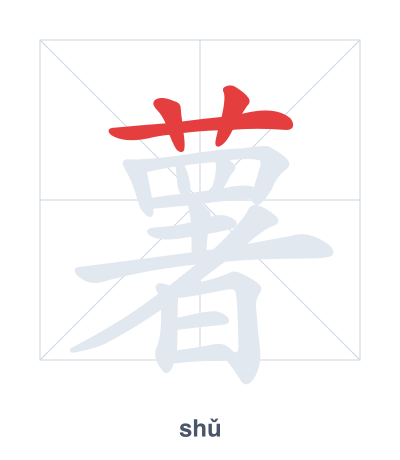
Open Hanzi Writer to see the animated stroke order and practice writing 薯 with real-time feedback.
The character 薯 (shǔ) is written with 16 strokes. Follow the standard Chinese stroke order: top to bottom, left to right, outside before inside. The radical 艹 is one of its key components.
Practice the correct stroke order with the Hanzi Writer app to see animated stroke-by-stroke guidance with real-time feedback.
薯 means Potato / Tuber.
As an HSK Level 6 character, 薯 is an intermediate-level character.
薯 is a phono-semantic compound: the top radical 艹 (grass/plant) indicates it's a type of plant, while the lower part 署 (shǔ) provides the sound. Ancient Chinese used 薯 to refer to yams and tubers growing underground, with the grass radical showing it's a crop.
💡 Memory Tip: Picture a potato wearing a tiny grass hat (艹) while signing paperwork at an office (署) — it's a 'tuber' working as an 'office' tuber!
冬天吃红薯很暖和。
dōng tiān chī hóng shǔ hěn nuǎn huo
Eating sweet potatoes in winter is very warming.
我喜欢吃炸薯条。
wǒ xǐ huān chī zhà shǔ tiáo
I like eating French fries.
马铃薯可以做成沙拉。
mǎ líng shǔ kě yǐ zuò chéng shā lā
Potatoes can be made into salad.
Open Hanzi Writer to see the animated stroke order and practice writing 薯 with real-time feedback.
✨ Animated stroke order · Handwriting recognition · HSK-graded practice · Free to use
薯 is composed of the grass radical 艹 on top and the phonetic component 署 (shǔ) below. The grass radical indicates that 薯 is a type of plant or tuber, while 署 provides the pronunciation. This structure tells you the character refers to edible underground plants like potatoes.