艻 (lè) means "fragrant grass; wild radish" in Chinese. It has 6 strokes with the radical 艹.
Rated 3.2/5 in difficulty (challenging).
Appears in 3+ common words including 艻草 (lè cǎo), 艻头 (lè tóu), 香艻 (xiāng lè).
Due to its 6 strokes, Hanzi Writer's error detection shows 艻 requires focused practice — most learners need 10+ attempts for consistent accuracy.
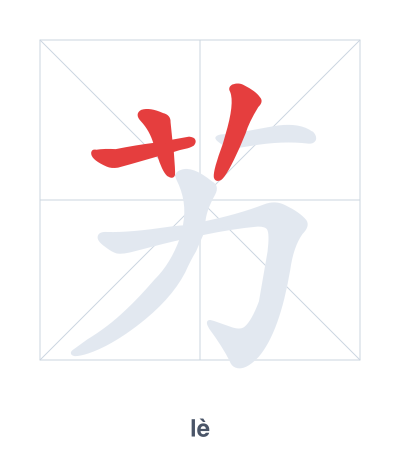
Open Hanzi Writer to see the animated stroke order and practice writing 艻 with real-time feedback.
The character 艻 (lè) is written with 6 strokes. Follow the standard Chinese stroke order: top to bottom, left to right, outside before inside. The radical 艹 is one of its key components.
Practice the correct stroke order with the Hanzi Writer app to see animated stroke-by-stroke guidance with real-time feedback.
艻 means fragrant grass; wild radish.
艻 is a compound character combining the grass radical 艹 with the phonetic component 力 (lì, 'strength'), indicating a type of fragrant plant or wild radish. The grass radical shows it is a plant, while 力 hints at its pronunciation lè.
💡 Memory Tip: Imagine a wild radish with such a powerful (力) scent that it makes the grass (艹) around it curl up.
路边长满了艻草。
lù biān zhǎng mǎn le lè cǎo
The roadside is overgrown with wild grass.
他在地里挖艻头。
tā zài dì lǐ wā lè tóu
He is digging up taro in the field.
这种香艻味道很淡。
zhè zhǒng xiāng lè wèi dào hěn dàn
This kind of herb has a very light scent.
Open Hanzi Writer to see the animated stroke order and practice writing 艻 with real-time feedback.
✨ Animated stroke order · Handwriting recognition · HSK-graded practice · Free to use
The character 艻 is made of the grass radical 艹 (meaning plant) on top and 力 (meaning power or strength) on the bottom. This combination suggests a strong or robust plant, which fits its meanings of fragrant grass and wild radish.