节 (jiē/jié) means "Festival / Section" in Chinese. It has 5 strokes with the radical 艹, and is HSK Level 2.
Rated 2.4/5 in difficulty (moderate).
Harder than 21% of HSK Level 2 characters.
Appears in 4+ common words including 节日 (jié rì), 节目 (jié mù), 节省 (jié shěng).
Hanzi Writer's stroke validation shows learners typically need 5-8 attempts to write 节 with correct proportion and order.
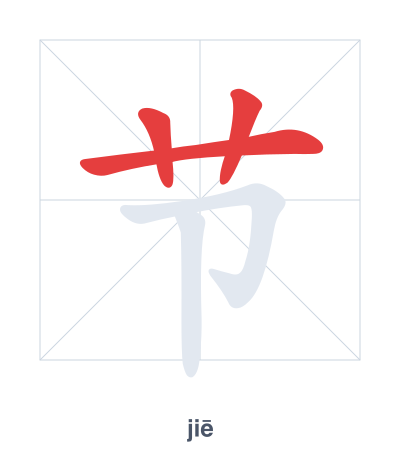
Open Hanzi Writer to see the animated stroke order and practice writing 节 with real-time feedback.
The character 节 (jiē/jié) is written with 5 strokes. Follow the standard Chinese stroke order: top to bottom, left to right, outside before inside. The radical 艹 is one of its key components.
Practice the correct stroke order with the Hanzi Writer app to see animated stroke-by-stroke guidance with real-time feedback.
节 means Festival / Section.
This is a polyphonic character with readings: jiē, jié.
As an HSK Level 2 character, 节 is among the first characters beginners learn.
The character 节 originally depicted a bamboo joint, combining the grass radical 艹 with 卩, which represents a knot or segment. This visually captures the idea of a 'section' or 'division,' later extended to mean a 'festival' as a segment of time.
💡 Memory Tip: Picture a stalk of grass (艹) tied in a tight knot (卩) to mark the start of a festival section.
祝你节日快乐!
zhù nǐ jié rì kuài lè
Happy holidays!
这个电视节目很有趣。
zhè ge diàn shì jié mù hěn yǒu qù
This TV show is very interesting.
我们要节省时间。
wǒ men yào jié shěng shí jiān
We should save time.
在这个节骨眼上,我们不能放弃。
zài zhè ge jiē gu yǎn shàng, wǒ men bù néng fàng qì
At this critical moment, we cannot give up.
Open Hanzi Writer to see the animated stroke order and practice writing 节 with real-time feedback.
✨ Animated stroke order · Handwriting recognition · HSK-graded practice · Free to use
节 has the radical 艹 (grass) on top, and a bottom part that looks like a knot or joint. The grass radical connects to plants, while the bottom shape suggests a section or joint, which relates to the meaning 'section'. The meaning 'festival' comes from the idea of seasonal sections marked by celebrations.