蒟 (jǔ) means "konjac; betel pepper" in Chinese. It has 14 strokes with the radical 艹.
Rated 4.2/5 in difficulty (advanced).
Appears in 3+ common words including 蒟蒻 (jǔ ruò), 蒟酱 (jǔ jiàng), 蒟子 (jǔ zi).
Due to its 14 strokes, Hanzi Writer's error detection shows 蒟 requires focused practice — most learners need 10+ attempts for consistent accuracy.
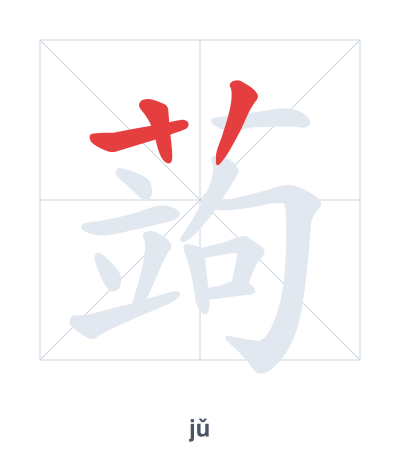
Open Hanzi Writer to see the animated stroke order and practice writing 蒟 with real-time feedback.
The character 蒟 (jǔ) is written with 14 strokes. Follow the standard Chinese stroke order: top to bottom, left to right, outside before inside. The radical 艹 is one of its key components.
Practice the correct stroke order with the Hanzi Writer app to see animated stroke-by-stroke guidance with real-time feedback.
蒟 means konjac; betel pepper.
蒟 is a phono-semantic compound formed with the radical 艹 (grass), indicating it is a plant, and the phonetic component 句 (jù), which provides the sound. It specifically refers to konjac (a plant used for its starchy tuber) or betel pepper, both of which are climbing or herbaceous plants.
💡 Memory Tip: Imagine a grass plant (艹) that grows into the shape of a sentence (句) because it wants to share its spicy betel pepper flavor with you.
蒟蒻很有嚼劲。
jǔ ruò hěn yǒu jué jìn
Konjac is very chewy.
这种蒟酱味道独特。
zhè zhǒng jǔ jiàng wèi dào dú tè
This betel pepper sauce has a unique flavor.
蒟子可以入药。
jǔ zi kě yǐ rù yào
Betel pepper fruit can be used as medicine.
Open Hanzi Writer to see the animated stroke order and practice writing 蒟 with real-time feedback.
✨ Animated stroke order · Handwriting recognition · HSK-graded practice · Free to use
蒟 is composed of the grass radical 艹 on top and the phonetic component 句 (jù) below. The grass radical connects it to plants like konjac and betel pepper. The bottom part 句 provides a hint for pronunciation but not meaning.