铃 (líng) means "bell" in Chinese. It has 10 strokes with the radical 钅, and is HSK Level 5.
Rated 4.2/5 in difficulty (advanced).
Harder than 97% of HSK Level 5 characters.
Appears in 3+ common words including 铃声 (líng shēng), 门铃 (mén líng), 铃铛 (líng dāng).
Due to its 10 strokes, Hanzi Writer's error detection shows 铃 requires focused practice — most learners need 10+ attempts for consistent accuracy.
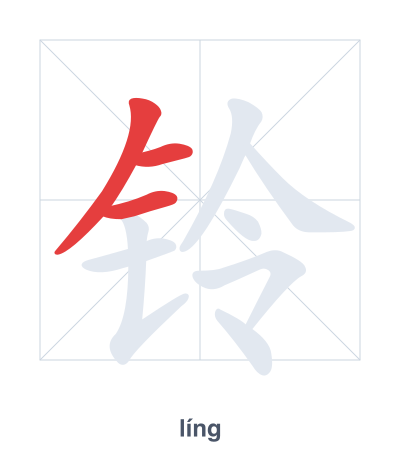
Open Hanzi Writer to see the animated stroke order and practice writing 铃 with real-time feedback.
The character 铃 (líng) is written with 10 strokes. Follow the standard Chinese stroke order: top to bottom, left to right, outside before inside. The radical 钅 is one of its key components.
Practice the correct stroke order with the Hanzi Writer app to see animated stroke-by-stroke guidance with real-time feedback.
铃 means bell.
As an HSK Level 5 character, 铃 is an intermediate-level character.
铃 is a phono-semantic compound: the left radical 钅 (metal) indicates the material, while the right component 令 (líng) provides the sound and hints at a command—bells were used to issue orders. Together, they form the meaning 'bell', a metal object that rings to signal or summon.
💡 Memory Tip: Imagine a metal (钅) bell that rings only when you give a clear command (令)—ding-a-ling!
手机铃声响了。
shǒu jī líng shēng xiǎng le
The phone ringtone is ringing.
有人在按门铃。
yǒu rén zài àn mén líng
Someone is ringing the doorbell.
小猫脖子上有铃铛。
xiǎo māo bó zi shàng yǒu líng dāng
The kitten has a bell on its neck.
Open Hanzi Writer to see the animated stroke order and practice writing 铃 with real-time feedback.
✨ Animated stroke order · Handwriting recognition · HSK-graded practice · Free to use
铃 is made of the radical 钅 (metal) on the left and 令 on the right. The metal radical shows bells are often made of metal, and 令 gives the pronunciation líng. Together they form a phono-semantic character meaning 'bell'.