蓂 (míng) means "Legendary lucky weed" in Chinese. It has 14 strokes with the radical 艹.
Rated 4.2/5 in difficulty (advanced).
Appears in 3+ common words including 蓂荚 (míng jiá), 历蓂 (lì míng), 瑞蓂 (ruì míng).
Due to its 14 strokes, Hanzi Writer's error detection shows 蓂 requires focused practice — most learners need 10+ attempts for consistent accuracy.
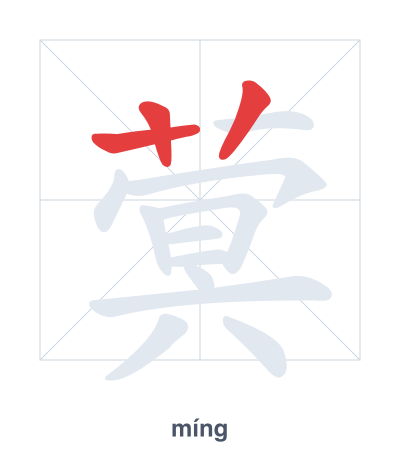
Open Hanzi Writer to see the animated stroke order and practice writing 蓂 with real-time feedback.
The character 蓂 (míng) is written with 14 strokes. Follow the standard Chinese stroke order: top to bottom, left to right, outside before inside. The radical 艹 is one of its key components.
Practice the correct stroke order with the Hanzi Writer app to see animated stroke-by-stroke guidance with real-time feedback.
蓂 means Legendary lucky weed.
蓂 combines the grass radical 艹 with 冥 (dark, obscure). The 冥 component hints at the legendary plant's mysterious nature, as it was believed to appear only in ideal conditions as an auspicious omen, often associated with hidden or obscure places.
💡 Memory Tip: Picture a lucky weed (艹) glowing in the dark (冥) like a magical plant that brings fortune when found.
传说中有一种草叫蓂荚。
chuán shuō zhōng yǒu yī zhǒng cǎo jiào míng jiá
Legend says there is a mythical plant called the Mingjia.
历蓂是古代的吉祥草。
lì míng shì gǔ dài de jí xiáng cǎo
The Limi is an ancient auspicious grass.
瑞蓂代表着好运。
ruì míng dài biǎo zhe hǎo yùn
Ruiming represents good luck.
Open Hanzi Writer to see the animated stroke order and practice writing 蓂 with real-time feedback.
✨ Animated stroke order · Handwriting recognition · HSK-graded practice · Free to use
蓂 has the grass radical 艹 on top, indicating it is a plant. The bottom part 冥 gives the pronunciation míng and also hints at its mysterious or hidden nature, as lucky plants are often considered mythical and rare.