蒻 (ruò) means "Young cattail" in Chinese. It has 14 strokes with the radical 艹.
Rated 4.2/5 in difficulty (advanced).
Appears in 3+ common words including 蒟蒻 (jǔ ruò), 蒻席 (ruò xí), 蒻草 (ruò cǎo).
Due to its 14 strokes, Hanzi Writer's error detection shows 蒻 requires focused practice — most learners need 10+ attempts for consistent accuracy.
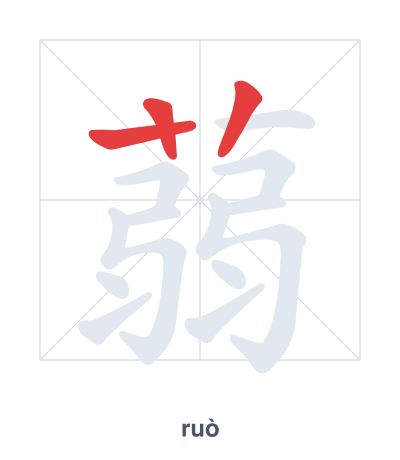
Open Hanzi Writer to see the animated stroke order and practice writing 蒻 with real-time feedback.
The character 蒻 (ruò) is written with 14 strokes. Follow the standard Chinese stroke order: top to bottom, left to right, outside before inside. The radical 艹 is one of its key components.
Practice the correct stroke order with the Hanzi Writer app to see animated stroke-by-stroke guidance with real-time feedback.
蒻 means Young cattail.
蒻 is a compound character with the grass radical 艹 indicating it's a plant, and the phonetic component 弱 (ruò, meaning weak or tender) which hints at the soft, young nature of the cattail shoots. The visual structure thus combines 'grass' with 'weak' to convey a young, tender cattail plant.
💡 Memory Tip: Picture a weak (弱) little cattail shoot pushing up through the grass (艹), so flimsy it bends in the breeze.
我喜欢吃蒟蒻。
wǒ xǐ huān chī jǔ ruò
I like eating konjac.
这是一张蒻席。
zhè shì yī zhāng ruò xí
This is a rush mat.
蒻草可以织席子。
ruò cǎo kě yǐ zhī xí zi
Fine mat grass can be used to weave mats.
Open Hanzi Writer to see the animated stroke order and practice writing 蒻 with real-time feedback.
✨ Animated stroke order · Handwriting recognition · HSK-graded practice · Free to use
蒻 is composed of the radical 艹 (grass) on top, indicating it is a plant, and the phonetic component 弱 (ruò, weak) below. The meaning 'young cattail' refers to the tender shoots of the cattail plant, which are soft and weak. So the character combines the idea of a grass-like plant with softness or weakness.