诈 (zhà) means "To cheat / To swindle / To feign" in Chinese. It has 7 strokes with the radical 讠, and is HSK Level 7.
Rated 3.2/5 in difficulty (challenging).
Harder than 11% of HSK Level 7 characters.
Appears in 3+ common words including 诈骗 (zhà piàn), 欺诈 (qī zhà), 诈称 (zhà chēng).
Due to its 7 strokes, Hanzi Writer's error detection shows 诈 requires focused practice — most learners need 10+ attempts for consistent accuracy.
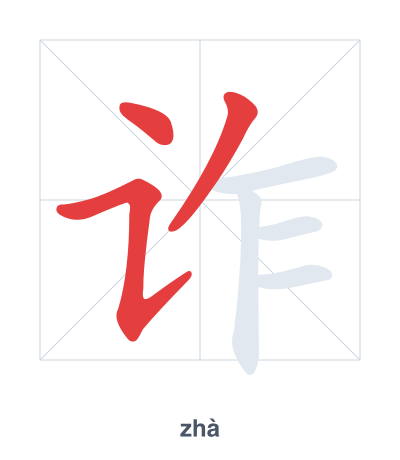
Open Hanzi Writer to see the animated stroke order and practice writing 诈 with real-time feedback.
The character 诈 (zhà) is written with 7 strokes. Follow the standard Chinese stroke order: top to bottom, left to right, outside before inside. The radical 讠 is one of its key components.
Practice the correct stroke order with the Hanzi Writer app to see animated stroke-by-stroke guidance with real-time feedback.
诈 means To cheat / To swindle / To feign.
As an HSK Level 7 character, 诈 is an intermediate-level character.
The character 诈 combines the speech radical 讠 (words) with the phonetic component 乍 (zhà, meaning 'suddenly' or 'to startle'). This pairing implies words that are suddenly deceptive or false, representing the act of cheating or feigning through speech.
💡 Memory Tip: Picture a person (讠) suddenly (乍) changing their story with a sly grin—that’s a swindler in action.
这是一个诈骗电话。
zhè shì yí gè zhà piàn diàn huà
This is a scam call.
这种行为属于欺诈。
zhè zhǒng xíng wéi shǔ yú qī zhà
This behavior constitutes fraud.
他诈称自己是医生。
tā zhà chēng zì jǐ shì yī shēng
He falsely claimed to be a doctor.
Open Hanzi Writer to see the animated stroke order and practice writing 诈 with real-time feedback.
✨ Animated stroke order · Handwriting recognition · HSK-graded practice · Free to use
诈 consists of the radical 讠 (speech) on the left and the component 乍 on the right. The radical 讠 suggests the character involves words or speech, while 乍 is a phonetic hint for the pronunciation zhà. Together, they indicate cheating or swindling through speech, like making false promises.