镜 (jìng) means "mirror or lens" in Chinese. It has 16 strokes with the radical 钅, and is HSK Level 4.
Rated 4.2/5 in difficulty (advanced).
Harder than 99% of HSK Level 4 characters.
Appears in 3+ common words including 镜子 (jìng zi), 眼镜 (yǎn jìng), 镜头 (jìng tóu).
Due to its 16 strokes, Hanzi Writer's error detection shows 镜 requires focused practice — most learners need 10+ attempts for consistent accuracy.
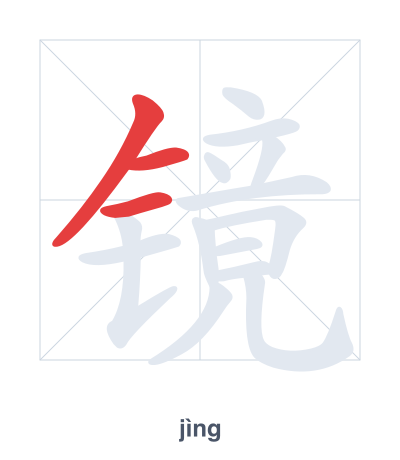
Open Hanzi Writer to see the animated stroke order and practice writing 镜 with real-time feedback.
The character 镜 (jìng) is written with 16 strokes. Follow the standard Chinese stroke order: top to bottom, left to right, outside before inside. The radical 钅 is one of its key components.
Practice the correct stroke order with the Hanzi Writer app to see animated stroke-by-stroke guidance with real-time feedback.
镜 means mirror or lens.
As an HSK Level 4 character, 镜 is an intermediate-level character.
镜 combines the radical 钅 (metal, indicating the material of ancient mirrors) with 竟 (jìng, 'finally' or 'the end'), which provides the pronunciation. Ancient mirrors were polished metal discs, so the metal radical directly connects to the meaning of 'mirror' and later 'lens.'
💡 Memory Tip: Picture a metal mirror (钅) showing the final scene (竟) of a movie—your own reflection.
他在照镜子。
tā zài zhào jìng zi
He is looking in the mirror.
我的眼镜找不到了。
wǒ de yǎn jìng zhǎo bú dào le
I can't find my glasses.
请看摄像机镜头。
qǐng kàn shè xiàng jī jìng tóu
Please look at the camera lens.
Open Hanzi Writer to see the animated stroke order and practice writing 镜 with real-time feedback.
✨ Animated stroke order · Handwriting recognition · HSK-graded practice · Free to use
镜 is a left-right character. The left radical 钅 means metal or gold, indicating that mirrors were originally made from polished metal. The right part 竟 provides the pronunciation jìng and also hints at the idea of a complete reflection.