钍 (tǔ) means "Thorium" in Chinese. It has 8 strokes with the radical 钅.
Rated 3.7/5 in difficulty (challenging).
Appears in 3+ common words including 钍元素 (tǔ yuán sù), 钍矿 (tǔ kuàng), 金属钍 (jīn shǔ tǔ).
Due to its 8 strokes, Hanzi Writer's error detection shows 钍 requires focused practice — most learners need 10+ attempts for consistent accuracy.
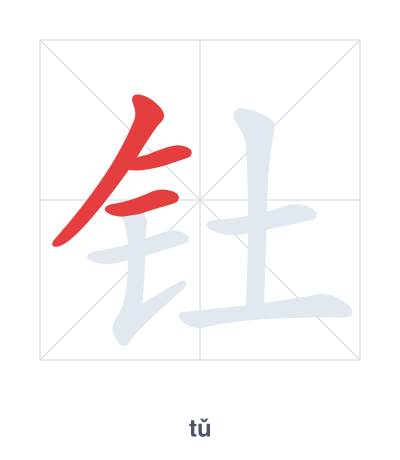
Open Hanzi Writer to see the animated stroke order and practice writing 钍 with real-time feedback.
The character 钍 (tǔ) is written with 8 strokes. Follow the standard Chinese stroke order: top to bottom, left to right, outside before inside. The radical 钅 is one of its key components.
Practice the correct stroke order with the Hanzi Writer app to see animated stroke-by-stroke guidance with real-time feedback.
钍 means Thorium.
钍 is a phono-semantic compound. The radical 钅 (metal) indicates it is a metallic element, while 土 (earth) provides the pronunciation tǔ and also hints that thorium is found in the earth's crust.
💡 Memory Tip: Picture a metal chunk (钅) dug out of the ground (土) that glows with radioactive energy — that's thorium.
钍可以用来产生核能。
tǔ kě yǐ yòng lái chǎn shēng hé néng
Thorium can be used to generate nuclear energy.
这里发现了一个钍矿。
zhè lǐ fā xiàn le yí gè tǔ kuàng
A thorium mine was discovered here.
金属钍是银白色的。
jīn shǔ tǔ shì yín bái sè de
Thorium metal is silvery-white.
Open Hanzi Writer to see the animated stroke order and practice writing 钍 with real-time feedback.
✨ Animated stroke order · Handwriting recognition · HSK-graded practice · Free to use
钍 combines the radical 钅 (gold/metal) on the left, indicating it is a metallic element, with 土 (earth) on the right, which gives the pronunciation tǔ. This structure follows the typical semantic-phonetic pattern: the left part hints at the meaning (metal), and the right part provides the sound.