钋 (pō) means "Polonium" in Chinese. It has 7 strokes with the radical 钅.
Rated 3.5/5 in difficulty (challenging).
Appears in 3+ common words including 钋元素 (pō yuán sù), 发现钋 (fā xiàn pō), 金属钋 (jīn shǔ pō).
Due to its 7 strokes, Hanzi Writer's error detection shows 钋 requires focused practice — most learners need 10+ attempts for consistent accuracy.
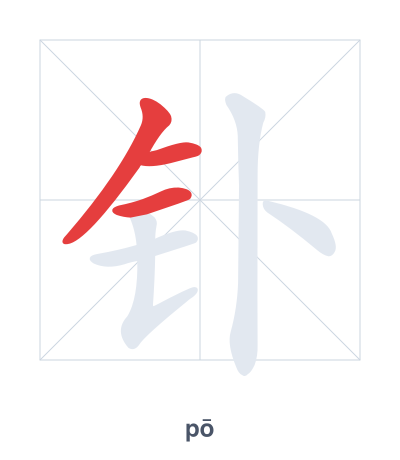
Open Hanzi Writer to see the animated stroke order and practice writing 钋 with real-time feedback.
The character 钋 (pō) is written with 7 strokes. Follow the standard Chinese stroke order: top to bottom, left to right, outside before inside. The radical 钅 is one of its key components.
Practice the correct stroke order with the Hanzi Writer app to see animated stroke-by-stroke guidance with real-time feedback.
钋 means Polonium.
钋 is a modern character created for the chemical element polonium. It combines the metal radical 钅, indicating it's a metallic element, with 卜 (bǔ), which provides a phonetic hint to its pronunciation pō. The character follows the common pattern for naming elements in Chinese.
💡 Memory Tip: Picture a metal (钅) fortune-teller using a divination stick (卜) to predict radioactive decay, which is polonium's dangerous property.
钋是一种放射性元素。
pō shì yī zhǒng fàng shè xìng yuán sù
Polonium is a radioactive element.
居里夫人发现了钋。
jū lǐ fū rén fā xiàn le pō
Madame Curie discovered polonium.
金属钋非常稀少。
jīn shǔ pō fēi cháng xī shǎo
Polonium metal is very rare.
Open Hanzi Writer to see the animated stroke order and practice writing 钋 with real-time feedback.
✨ Animated stroke order · Handwriting recognition · HSK-graded practice · Free to use
钋 is composed of the radical 钅 (jīn, meaning gold or metal) on the left and the phonetic component 卜 (bǔ) on the right. The radical shows that polonium is a metal, while 卜 provides a sound hint for the pronunciation pō. Together they convey that 钋 is a metallic element.