锲 (qiè) means "to carve; to engrave" in Chinese. It has 14 strokes with the radical 钅.
Rated 4.2/5 in difficulty (advanced).
Appears in 3+ common words including 锲而不舍 (qiè ér bù shě), 锲刻 (qiè kè), 锲入 (qiè rù).
Due to its 14 strokes, Hanzi Writer's error detection shows 锲 requires focused practice — most learners need 10+ attempts for consistent accuracy.
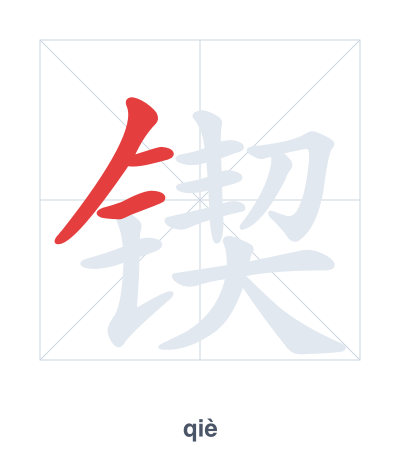
Open Hanzi Writer to see the animated stroke order and practice writing 锲 with real-time feedback.
The character 锲 (qiè) is written with 14 strokes. Follow the standard Chinese stroke order: top to bottom, left to right, outside before inside. The radical 钅 is one of its key components.
Practice the correct stroke order with the Hanzi Writer app to see animated stroke-by-stroke guidance with real-time feedback.
锲 means to carve; to engrave.
The character 锲 combines the metal radical 钅 (jīn, 'gold/metal') with 契 (qì), a component that originally depicted carving notches into a tally stick using a knife (刀). Together, they mean 'to carve or engrave with a metal tool.'
💡 Memory Tip: Picture a metal blade (钅) and a knife (契's 刀) working together to carve deep notches into a stone tablet.
学习要锲而不舍。
xué xí yào qiè ér bù shě
One must persevere in their studies.
他在木头上锲刻。
tā zài mù tou shàng qiè kè
He is carving on the wood.
钉子锲入木板。
dīng zi qiè rù mù bǎn
The nail is driven into the wooden board.
Open Hanzi Writer to see the animated stroke order and practice writing 锲 with real-time feedback.
✨ Animated stroke order · Handwriting recognition · HSK-graded practice · Free to use
锲 combines the metal radical 钅 (jīn) on the left with 契 (qì, meaning 'engrave' or 'contract') on the right. The metal radical indicates that the action involves a metal tool, while 契 gives both the sound and the core idea of carving or cutting into a surface.