竟 (jìng) means "Unexpectedly; actually; to finish" in Chinese. It has 11 strokes with the radical 立, and is HSK Level 4.
Rated 3.9/5 in difficulty (challenging).
Harder than 54% of HSK Level 4 characters.
Appears in 3+ common words including 竟然 (jìng rán), 毕竟 (bì jìng), 究竟 (jiū jìng).
Due to its 11 strokes, Hanzi Writer's error detection shows 竟 requires focused practice — most learners need 10+ attempts for consistent accuracy.
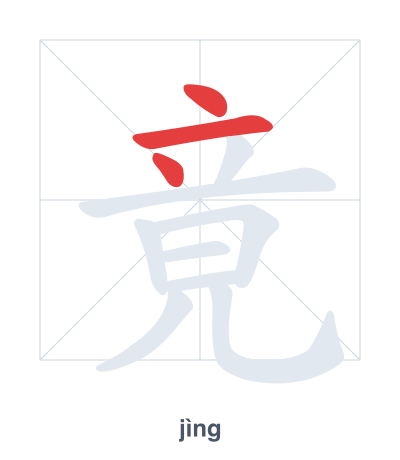
Open Hanzi Writer to see the animated stroke order and practice writing 竟 with real-time feedback.
The character 竟 (jìng) is written with 11 strokes. Follow the standard Chinese stroke order: top to bottom, left to right, outside before inside. The radical 立 is one of its key components.
Practice the correct stroke order with the Hanzi Writer app to see animated stroke-by-stroke guidance with real-time feedback.
竟 means Unexpectedly; actually; to finish.
As an HSK Level 4 character, 竟 is an intermediate-level character.
竟 originally showed a person (儿) standing with a musical instrument (音) on their head, representing the end of a performance. This led to the meanings 'to finish' and 'finally', which later extended to 'unexpectedly' as in something happening at the very end.
💡 Memory Tip: Imagine standing (立) and saying (曰) something with your legs (儿) apart, then you unexpectedly (竟) trip and fall at the finish.
他竟然忘了我的名字。
tā jìng rán wàng le wǒ de míng zì
He actually forgot my name.
他毕竟还是个孩子。
tā bì jìng hái shì gè hái zi
After all, he is still a child.
你究竟想说什么?
nǐ jiū jìng xiǎng shuō shén me
What exactly do you want to say?
Open Hanzi Writer to see the animated stroke order and practice writing 竟 with real-time feedback.
✨ Animated stroke order · Handwriting recognition · HSK-graded practice · Free to use
竟 consists of 音 (sound) on top and 儿 (legs) at the bottom, but in this character the top part is actually a variant of 㐭 (a pictograph of a building), and the bottom 儿 represents legs. Together they suggest the idea of 'finishing a song or speech' and then 'unexpectedly' moving away. The meaning 'unexpectedly' developed from the sense of something being completed in a surprising way.