童 (tóng) means "Child; childhood" in Chinese. It has 12 strokes with the radical 立, and is HSK Level 4.
Rated 4.2/5 in difficulty (advanced).
Harder than 83% of HSK Level 4 characters.
Appears in 3+ common words including 儿童 (ér tóng), 童话 (tóng huà), 童年 (tóng nián).
Due to its 12 strokes, Hanzi Writer's error detection shows 童 requires focused practice — most learners need 10+ attempts for consistent accuracy.
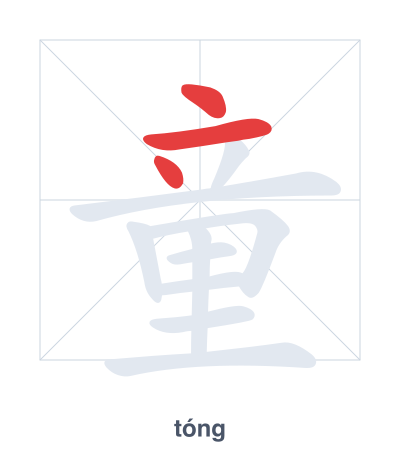
Open Hanzi Writer to see the animated stroke order and practice writing 童 with real-time feedback.
The character 童 (tóng) is written with 12 strokes. Follow the standard Chinese stroke order: top to bottom, left to right, outside before inside. The radical 立 is one of its key components.
Practice the correct stroke order with the Hanzi Writer app to see animated stroke-by-stroke guidance with real-time feedback.
童 means Child; childhood.
As an HSK Level 4 character, 童 is an intermediate-level character.
Originally a pictograph of a child with a distinctive topknot hairstyle, the character later became a compound of 立 (to stand) and 里 (village). The top component 立 suggests an upright posture, while the whole anciently depicted a standing person, later generalized to mean 'child' or 'childhood.'
💡 Memory Tip: A child stands (立) in the village (里), playing with other kids.
这里有很多儿童。
zhè lǐ yǒu hěn duō ér tóng
There are many children here.
我喜欢看童话。
wǒ xǐ huān kàn tóng huà
I like reading fairy tales.
我的童年很快乐。
wǒ de tóng nián hěn kuài lè
My childhood was very happy.
Open Hanzi Writer to see the animated stroke order and practice writing 童 with real-time feedback.
✨ Animated stroke order · Handwriting recognition · HSK-graded practice · Free to use
童 combines the radical 立 (standing) on top and 里 (village/inside) below. This structure suggests a child standing in or within a village, linking to the idea of childhood and youth.