立 (lì) means "To stand; to establish; immediately" in Chinese. It has 5 strokes with the radical 立, and is HSK Level 3.
Rated 2.3/5 in difficulty (moderate).
Harder than 3% of HSK Level 3 characters.
Appears in 3+ common words including 站立 (zhàn lì), 立即 (lì jí), 建立 (jiàn lì).
Hanzi Writer's stroke validation shows learners typically need 5-8 attempts to write 立 with correct proportion and order.
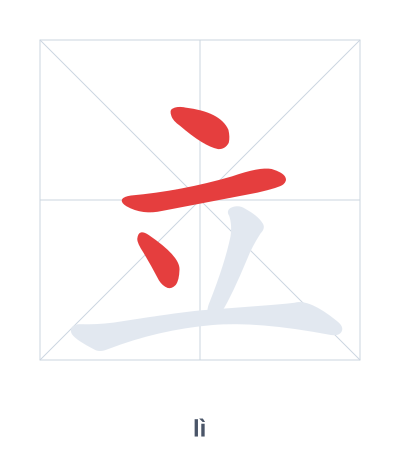
Open Hanzi Writer to see the animated stroke order and practice writing 立 with real-time feedback.
The character 立 (lì) is written with 5 strokes. Follow the standard Chinese stroke order: top to bottom, left to right, outside before inside. The radical 立 is one of its key components.
Practice the correct stroke order with the Hanzi Writer app to see animated stroke-by-stroke guidance with real-time feedback.
立 means To stand; to establish; immediately.
As an HSK Level 3 character, 立 is an intermediate-level character.
The ancient form of 立 depicted a person standing upright with arms outstretched, feet planted on the ground. Over time, it simplified to five strokes: the top dot represents the head, the horizontal line the arms, the bottom line the ground, and the vertical stroke the body. This pictograph directly conveys the idea of standing or being in an upright position.
💡 Memory Tip: Imagine a person standing at attention on a flat line (ground), with arms stretched out to the sides and a dot for a head—like a tiny stick figure saying 'I'm here, standing tall!'
请大家站立。
qǐng dà jiā zhàn lì
Everyone, please stand up.
我立即就去。
wǒ lì jí jiù qù
I'll go right away.
我们建立了良好的关系。
wǒ men jiàn lì le liáng hǎo de guān xì
We have built a good relationship.
Open Hanzi Writer to see the animated stroke order and practice writing 立 with real-time feedback.
✨ Animated stroke order · Handwriting recognition · HSK-graded practice · Free to use
The character 立 is a pictograph that originally depicted a person standing upright on the ground. The top part looks like a head and shoulders, while the bottom line represents the ground, symbolizing the idea of standing. This simple form directly conveys the core meaning of "to stand."