竖 (shù) means "Vertical; to set upright" in Chinese. It has 9 strokes with the radical 立, and is HSK Level 7.
Rated 4/5 in difficulty (challenging).
Harder than 44% of HSK Level 7 characters.
Appears in 3+ common words including 竖线 (shù xiàn), 竖立 (shù lì), 横竖 (héng shù).
Due to its 9 strokes, Hanzi Writer's error detection shows 竖 requires focused practice — most learners need 10+ attempts for consistent accuracy.
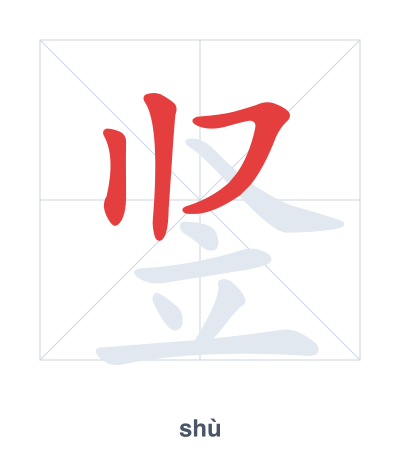
Open Hanzi Writer to see the animated stroke order and practice writing 竖 with real-time feedback.
The character 竖 (shù) is written with 9 strokes. Follow the standard Chinese stroke order: top to bottom, left to right, outside before inside. The radical 立 is one of its key components.
Practice the correct stroke order with the Hanzi Writer app to see animated stroke-by-stroke guidance with real-time feedback.
竖 means Vertical; to set upright.
As an HSK Level 7 character, 竖 is an intermediate-level character.
竖 combines 立 (to stand upright) on top and 豆 (a ritual vessel) below. The top component gives the meaning of standing straight, while the bottom originally served as a phonetic element, together suggesting something set vertically upright.
💡 Memory Tip: Picture a vertical pole (立) balanced on top of a bean-shaped vessel (豆) to remember 'vertical'.
请画一条竖线。
qǐng huà yī tiáo shù xiàn
Please draw a vertical line.
门口竖立着一块牌子。
mén kǒu shù lì zhe yī kuài pái zi
A sign is standing at the entrance.
横竖你都要去。
héng shù nǐ dōu yào qù
Anyway, you have to go.
Open Hanzi Writer to see the animated stroke order and practice writing 竖 with real-time feedback.
✨ Animated stroke order · Handwriting recognition · HSK-graded practice · Free to use
竖 is made of two parts: the left side 立 (meaning 'to stand') and the right side 㐅 (a simplified form related to 'vertical'). Together, they suggest something standing upright, which matches the character's meaning of 'vertical' or 'to set upright.'