然 (rán) means "so, correct, or but" in Chinese. It has 12 strokes with the radical 灬, and is HSK Level 2.
Rated 3.7/5 in difficulty (challenging).
Harder than 83% of HSK Level 2 characters.
Appears in 3+ common words including 然后 (rán hòu), 虽然 (suī rán), 当然 (dāng rán).
Due to its 12 strokes, Hanzi Writer's error detection shows 然 requires focused practice — most learners need 10+ attempts for consistent accuracy.
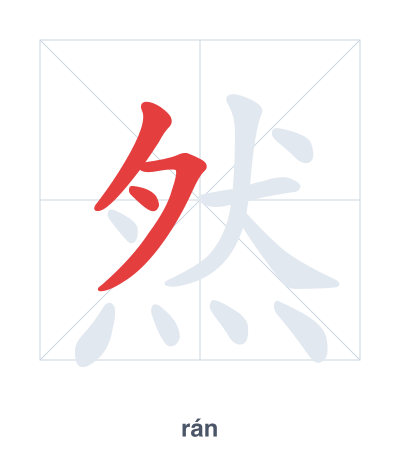
Open Hanzi Writer to see the animated stroke order and practice writing 然 with real-time feedback.
The character 然 (rán) is written with 12 strokes. Follow the standard Chinese stroke order: top to bottom, left to right, outside before inside. The radical 灬 is one of its key components.
Practice the correct stroke order with the Hanzi Writer app to see animated stroke-by-stroke guidance with real-time feedback.
然 means so, correct, or but.
As an HSK Level 2 character, 然 is among the first characters beginners learn.
Originally composed of 肙 (meat) over 灬 (fire), depicting meat roasting over flames—meaning 'to burn'. It was later borrowed to function as a particle meaning 'so, correct' or 'but' in classical Chinese, losing its original sense to the derivative 燃.
💡 Memory Tip: Picture a dog (the top left resembling 犬) warming itself by a fire (灬), nodding and thinking, 'So, that's correct, but it's hot.'
我先吃饭,然后睡觉。
wǒ xiān chī fàn rán hòu shuì jiào
I'll eat first, then sleep.
虽然很累,但我很开心。
suī rán hěn lèi dàn wǒ hěn kāi xīn
Although I'm tired, I'm very happy.
我当然会去。
wǒ dāng rán huì qù
Of course I will go.
Open Hanzi Writer to see the animated stroke order and practice writing 然 with real-time feedback.
✨ Animated stroke order · Handwriting recognition · HSK-graded practice · Free to use
The character 然 is made of two parts: the top part 肙 (a phonetic component) and the bottom radical 灬 (fire). Originally, 然 meant 'to burn' (like 燃), but now it is used abstractly to mean 'so', 'correct', or 'but' in modern Chinese.