竦 (sǒng) means "To stand in awe; to respect" in Chinese. It has 12 strokes with the radical 立.
Rated 4.2/5 in difficulty (advanced).
Appears in 3+ common words including 竦立 (sǒng lì), 竦然 (sǒng rán), 竦动 (sǒng dòng).
Due to its 12 strokes, Hanzi Writer's error detection shows 竦 requires focused practice — most learners need 10+ attempts for consistent accuracy.
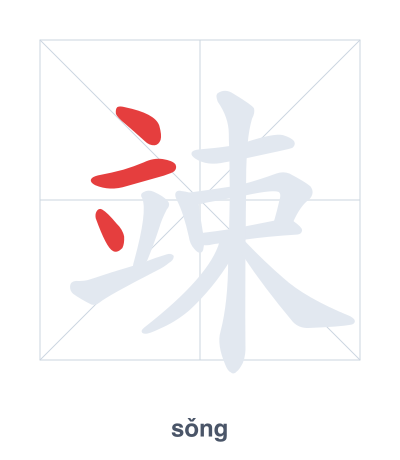
Open Hanzi Writer to see the animated stroke order and practice writing 竦 with real-time feedback.
The character 竦 (sǒng) is written with 12 strokes. Follow the standard Chinese stroke order: top to bottom, left to right, outside before inside. The radical 立 is one of its key components.
Practice the correct stroke order with the Hanzi Writer app to see animated stroke-by-stroke guidance with real-time feedback.
竦 means To stand in awe; to respect.
| Character | 竦 |
| Pinyin | sǒng (song) |
| Meaning | To stand in awe; to respect |
| Strokes | 12 |
| Radical | 立 |
| Difficulty | 4.2/5 |
竦 combines the radical 立 (standing) with 束 (to bind or bundle), which also provides phonetic value. The image is of standing rigidly, as if bound or restrained by awe, conveying a posture of respectful fear or reverence.
💡 Memory Tip: Picture a person standing at attention (立) with their arms tied tightly (束) because they are so awestruck by a majestic sight.
他在门外竦立着。
tā zài mén wài sǒng lì zhe
He is standing straight outside the door.
消息令人竦然。
xiāo xī lìng rén sǒng rán
The news is horrifying.
他的眉毛竦动了一下。
tā de méi máo sǒng dòng le yī xià
His eyebrows twitched slightly.
Open Hanzi Writer to see the animated stroke order and practice writing 竦 with real-time feedback.
✨ Animated stroke order · Handwriting recognition · HSK-graded practice · Free to use
竦 is made of two parts: the radical 立 (standing) on top and 束 (to bind) below. The radical 立 gives the idea of standing upright, while 束 suggests being bound or restrained, together creating the meaning of standing in awe or respect.