毕 (bì) means "To finish; to complete" in Chinese. It has 6 strokes with the radical 比, and is HSK Level 4.
Rated 3.2/5 in difficulty (challenging).
Harder than 22% of HSK Level 4 characters.
Appears in 3+ common words including 毕业 (bì yè), 完毕 (wán bì), 毕竟 (bì jìng).
Due to its 6 strokes, Hanzi Writer's error detection shows 毕 requires focused practice — most learners need 10+ attempts for consistent accuracy.
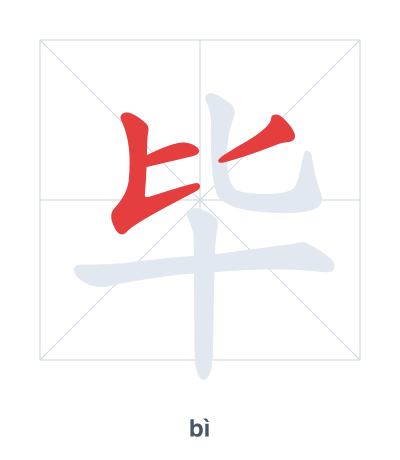
Open Hanzi Writer to see the animated stroke order and practice writing 毕 with real-time feedback.
The character 毕 (bì) is written with 6 strokes. Follow the standard Chinese stroke order: top to bottom, left to right, outside before inside. The radical 比 is one of its key components.
Practice the correct stroke order with the Hanzi Writer app to see animated stroke-by-stroke guidance with real-time feedback.
毕 means To finish; to complete.
As an HSK Level 4 character, 毕 is an intermediate-level character.
The character 毕 is a simplified form of traditional 畢, which originally depicted a net with a handle (田 over 廾) used for catching birds or game—catching everything meant 'to finish.' In the simplified version, the components 比 (compare) and 十 (ten) suggest the idea of 'ten comparisons' or 'all counted up,' symbolizing completion.
💡 Memory Tip: Picture a race (比) where the finish line is marked by a big number ten (十)—when you cross it, you're done (毕).
我大学毕业了。
wǒ dà xué bì yè le
I graduated from university.
工作已经完毕。
gōng zuò yǐ jīng wán bì
The work is finished.
他毕竟还是个孩子。
tā bì jìng hái shì gè hái zi
After all, he is still a child.
Open Hanzi Writer to see the animated stroke order and practice writing 毕 with real-time feedback.
✨ Animated stroke order · Handwriting recognition · HSK-graded practice · Free to use
毕 is composed of the radical 比 (bǐ, meaning 'compare' or 'ratio') on top and the component 十 (shí, meaning 'ten') below. The top part 比 suggests a comparison or pairing, while the bottom 十 can imply completeness, together hinting at finishing or concluding a process.