苦 (kǔ) means "Bitter / hardship" in Chinese. It has 8 strokes with the radical 艹, and is HSK Level 3.
Rated 3.7/5 in difficulty (challenging).
Harder than 53% of HSK Level 3 characters.
Appears in 3+ common words including 辛苦 (xīn kǔ), 苦瓜 (kǔ guā), 痛苦 (tòng kǔ).
Due to its 8 strokes, Hanzi Writer's error detection shows 苦 requires focused practice — most learners need 10+ attempts for consistent accuracy.
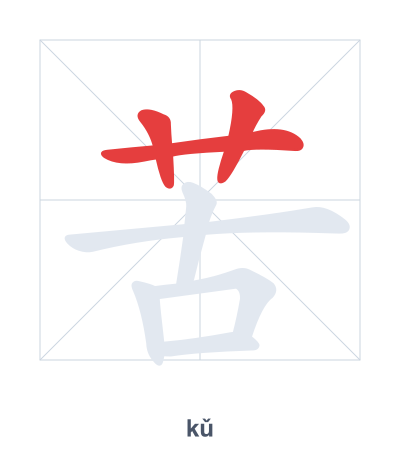
Open Hanzi Writer to see the animated stroke order and practice writing 苦 with real-time feedback.
The character 苦 (kǔ) is written with 8 strokes. Follow the standard Chinese stroke order: top to bottom, left to right, outside before inside. The radical 艹 is one of its key components.
Practice the correct stroke order with the Hanzi Writer app to see animated stroke-by-stroke guidance with real-time feedback.
苦 means Bitter / hardship.
As an HSK Level 3 character, 苦 is an intermediate-level character.
苦 is a compound character formed with the grass radical 艹 (艸) on top and 古 (old/ancient) below. Originally it depicted a bitter herb or plant that was unpleasant to taste, with 'old grass' metaphorically conveying the sense of hardship or bitterness over time.
💡 Memory Tip: Imagine chewing on an old (古) piece of grass (艹) — the intensely bitter taste makes you wince in hardship.
你工作很辛苦。
nǐ gōng zuò hěn xīn kǔ
You work very hard.
苦瓜的味道很苦。
kǔ guā de wèi dào hěn kǔ
Bitter melon tastes very bitter.
他感到非常痛苦。
tā gǎn dào fēi cháng tòng kǔ
He feels very pained.
Open Hanzi Writer to see the animated stroke order and practice writing 苦 with real-time feedback.
✨ Animated stroke order · Handwriting recognition · HSK-graded practice · Free to use
The character 苦 has the radical 艹 (grass) on top and 古 (ancient) below. The grass radical suggests plants, and the ancient part implies a long-standing bitter taste. Together, the character originally referred to the bitter taste of certain plants.