眉 (méi) means "eyebrow" in Chinese. It has 9 strokes with the radical 目, and is HSK Level 7.
Rated 4/5 in difficulty (challenging).
Harder than 43% of HSK Level 7 characters.
Appears in 3+ common words including 眉毛 (méi máo), 眉头 (méi tóu), 眉目 (méi mù).
Due to its 9 strokes, Hanzi Writer's error detection shows 眉 requires focused practice — most learners need 10+ attempts for consistent accuracy.
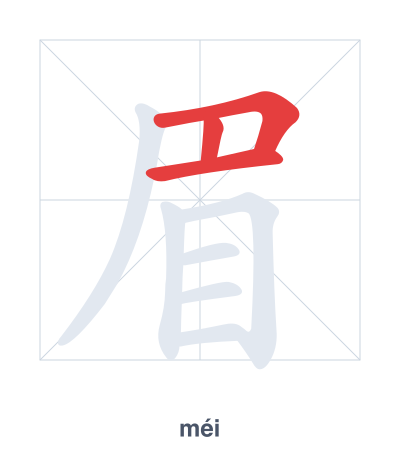
Open Hanzi Writer to see the animated stroke order and practice writing 眉 with real-time feedback.
The character 眉 (méi) is written with 9 strokes. Follow the standard Chinese stroke order: top to bottom, left to right, outside before inside. The radical 目 is one of its key components.
Practice the correct stroke order with the Hanzi Writer app to see animated stroke-by-stroke guidance with real-time feedback.
眉 means eyebrow.
As an HSK Level 7 character, 眉 is an intermediate-level character.
眉 is a pictograph that originally depicted an eye (目) with a curved line above it representing the eyebrow. The top portion (resembling 厂 with an extra stroke) visually sketches the brow's arch and hairs, while the lower 目 anchors the meaning to the eye.
💡 Memory Tip: Picture the top strokes as a bushy eyebrow arching dramatically over the single eye (目) below, as if raising one brow in surprise.
他的眉毛又黑又浓。
tā de méi máo yòu hēi yòu nóng
His eyebrows are dark and thick.
他皱起眉头在思考。
tā zhòu qǐ méi tóu zài sī kǎo
He frowned while thinking.
这件事终于有了眉目。
zhè jiàn shì zhōng yú yǒu le méi mù
This matter is finally starting to take shape.
Open Hanzi Writer to see the animated stroke order and practice writing 眉 with real-time feedback.
✨ Animated stroke order · Handwriting recognition · HSK-graded practice · Free to use
The character 眉 consists of an eyebrow-like shape above the radical 目 (eye). The top part represents the hair of the eyebrow, while 目 indicates the eye below. Together, they clearly show an eyebrow above an eye, which directly gives the meaning 'eyebrow'.