脸 (liǎn) means "face" in Chinese. It has 11 strokes with the radical ⺼, and is HSK Level 2.
Rated 3.7/5 in difficulty (challenging).
Harder than 92% of HSK Level 2 characters.
Appears in 3+ common words including 洗脸 (xǐ liǎn), 脸红 (liǎn hóng), 丢脸 (diū liǎn).
Due to its 11 strokes, Hanzi Writer's error detection shows 脸 requires focused practice — most learners need 10+ attempts for consistent accuracy.
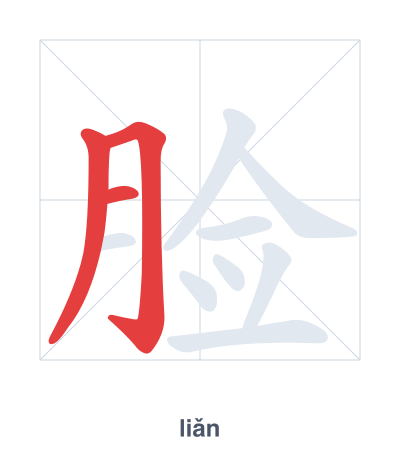
Open Hanzi Writer to see the animated stroke order and practice writing 脸 with real-time feedback.
The character 脸 (liǎn) is written with 11 strokes. Follow the standard Chinese stroke order: top to bottom, left to right, outside before inside. The radical ⺼ is one of its key components.
Practice the correct stroke order with the Hanzi Writer app to see animated stroke-by-stroke guidance with real-time feedback.
脸 means face.
As an HSK Level 2 character, 脸 is among the first characters beginners learn.
The character 脸 combines the flesh radical ⺼ (indicating body parts) with 佥 (qiān, meaning 'all' or 'together'), suggesting the face as the fleshy area where all features converge. Originally it referred specifically to the cheeks, the fleshy part of the face.
💡 Memory Tip: Picture a face where the fleshy cheeks (⺼) gather all (佥) expressions together.
我每天早上洗脸。
wǒ měi tiān zǎo shàng xǐ liǎn
I wash my face every morning.
她害羞得脸红了。
tā hài xiū dé liǎn hóng le
She blushed with shyness.
这样做很丢脸。
zhè yàng zuò hěn diū liǎn
Doing this is very embarrassing.
Open Hanzi Writer to see the animated stroke order and practice writing 脸 with real-time feedback.
✨ Animated stroke order · Handwriting recognition · HSK-graded practice · Free to use
The left component ⺼ is the meat radical, which often appears in characters related to body parts. The right component 佥 gives a clue to pronunciation and also suggests the idea of "together" or "all," hinting that the face is where all features come together.