重 (chóng/zhòng) means "Heavy" in Chinese. It has 9 strokes with the radical 里, and is HSK Level 1.
Rated 3.5/5 in difficulty (challenging).
Harder than 83% of HSK Level 1 characters.
Appears in 4+ common words including 重量 (zhòng liàng), 重要 (zhòng yào), 重复 (chóng fù).
Due to its 9 strokes, Hanzi Writer's error detection shows 重 requires focused practice — most learners need 10+ attempts for consistent accuracy.
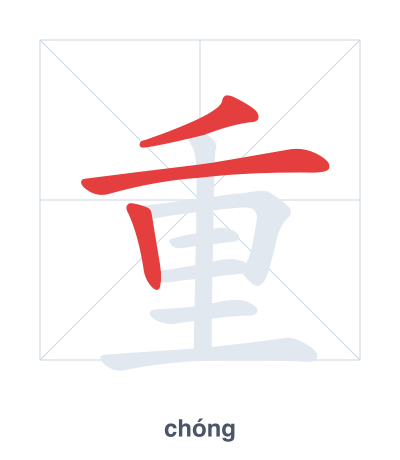
Open Hanzi Writer to see the animated stroke order and practice writing 重 with real-time feedback.
The character 重 (chóng/zhòng) is written with 9 strokes. Follow the standard Chinese stroke order: top to bottom, left to right, outside before inside. The radical 里 is one of its key components.
Practice the correct stroke order with the Hanzi Writer app to see animated stroke-by-stroke guidance with real-time feedback.
重 means Heavy.
This is a polyphonic character with readings: chóng, zhòng.
As an HSK Level 1 character, 重 is among the first characters beginners learn.
Originally a pictograph of a person (人) carrying a heavy bundle (東) on their back, symbolizing weight. The modern form simplifies these elements, with the top part (千) representing the person and the bottom (里) the bundle.
💡 Memory Tip: Picture a person (the left stroke) straining to lift a thousand (千) pounds inside a field (里) — it's incredibly heavy!
测量一下这台机器的重量是多少。
cè liáng yī xià zhè tái jī qì de zhòng liàng shì duō shǎo
Measure the weight of this machine.
环境保护对人类来说非常重要。
huán jìng bǎo hù duì rén lèi lái shuō fēi cháng zhòng yào
Environmental protection is very important for humanity.
同样的话他已经重复了三遍。
tóng yàng de huà tā yǐ jīng chóng fù le sān biàn
He has already repeated the same words three times.
我们需要重新评估这个项目的可行性。
wǒ men xū yào chóng xīn píng gū zhè ge xiàng mù dì kě xíng xìng
We need to re-evaluate the feasibility of this project.
Open Hanzi Writer to see the animated stroke order and practice writing 重 with real-time feedback.
✨ Animated stroke order · Handwriting recognition · HSK-graded practice · Free to use
The character 重 is made up of the radical 里 (village) at the bottom and a top part that looks like 千 (thousand). Although these components don't directly mean 'heavy,' the character's meaning comes from its ancient form showing a person carrying a heavy load.