荷 (hé) means "Lotus" in Chinese. It has 10 strokes with the radical 艹, and is HSK Level 7.
Rated 4.2/5 in difficulty (advanced).
Harder than 85% of HSK Level 7 characters.
Appears in 3+ common words including 荷花 (hé huā), 荷兰 (hé lán), 荷包 (hé bāo).
Due to its 10 strokes, Hanzi Writer's error detection shows 荷 requires focused practice — most learners need 10+ attempts for consistent accuracy.
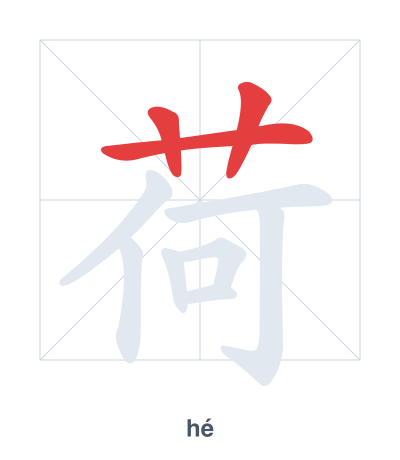
Open Hanzi Writer to see the animated stroke order and practice writing 荷 with real-time feedback.
The character 荷 (hé) is written with 10 strokes. Follow the standard Chinese stroke order: top to bottom, left to right, outside before inside. The radical 艹 is one of its key components.
Practice the correct stroke order with the Hanzi Writer app to see animated stroke-by-stroke guidance with real-time feedback.
荷 means Lotus.
As an HSK Level 7 character, 荷 is an intermediate-level character.
荷 is a phono-semantic compound with the grass radical 艹 indicating a plant, and the phonetic component 何 (hé) providing the sound. The character represents the lotus, an aquatic flowering plant with broad leaves and fragrant blossoms.
💡 Memory Tip: Picture a lotus plant with a person (亻) beside it asking 'Can (可) I pick this flower?' — that's 荷.
池塘里的荷花开了。
chí táng lǐ de hé huā kāi le
The lotus flowers in the pond have bloomed.
他去年去了荷兰。
tā qù nián qù le hé lán
He went to the Netherlands last year.
他的荷包里有钱。
tā de hé bāo lǐ yǒu qián
He has money in his pocket.
Open Hanzi Writer to see the animated stroke order and practice writing 荷 with real-time feedback.
✨ Animated stroke order · Handwriting recognition · HSK-graded practice · Free to use
荷 is a top-bottom structure. The top part 艹 (grass radical) indicates it is a plant, and the bottom part 何 (hé) provides the sound and also originally meant 'to carry.' Together, they mean a plant that carries its flowers above water — the lotus.