稀 (xī) means "rare; thin; sparse" in Chinese. It has 12 strokes with the radical 禾, and is HSK Level 7.
Rated 4.2/5 in difficulty (advanced).
Harder than 76% of HSK Level 7 characters.
Appears in 3+ common words including 稀少 (xī shǎo), 稀饭 (xī fàn), 稀奇 (xī qí).
Due to its 12 strokes, Hanzi Writer's error detection shows 稀 requires focused practice — most learners need 10+ attempts for consistent accuracy.
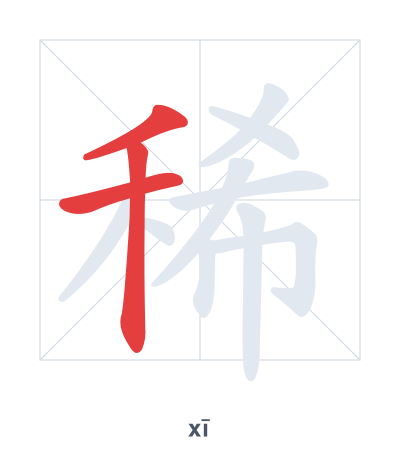
Open Hanzi Writer to see the animated stroke order and practice writing 稀 with real-time feedback.
The character 稀 (xī) is written with 12 strokes. Follow the standard Chinese stroke order: top to bottom, left to right, outside before inside. The radical 禾 is one of its key components.
Practice the correct stroke order with the Hanzi Writer app to see animated stroke-by-stroke guidance with real-time feedback.
稀 means rare; thin; sparse.
As an HSK Level 7 character, 稀 is an intermediate-level character.
This character combines the radical 禾 (grain) with 希 (xī), which provides pronunciation and also suggests the meaning of 'rare' or 'few'. The original idea is of grain plants planted far apart, resulting in a thin or sparse crop.
💡 Memory Tip: Imagine a grain field (禾) so sparse that you can see a rare cloth (巾) with a cross (乂) pattern hanging between the stalks.
这里的病人很稀少。
zhè lǐ de bìng rén hěn xī shǎo
Patients here are very few.
我早餐喜欢喝稀饭。
wǒ zǎo cān xǐ huān hē xī fàn
I like having congee for breakfast.
这件事并不稀奇。
zhè jiàn shì bìng bù xī qí
This matter is not unusual.
Open Hanzi Writer to see the animated stroke order and practice writing 稀 with real-time feedback.
✨ Animated stroke order · Handwriting recognition · HSK-graded practice · Free to use
稀 is made of the left radical 禾 (grain) and the right part 希 (xī, meaning rare). Together, 禾 suggests something related to crops, while 希 adds the idea of rarity or sparseness — so 稀 often describes grain plants that are thinly spaced or scarce.