障 (zhàng) means "barrier; to block" in Chinese. It has 13 strokes with the radical 阝, and is HSK Level 6.
Rated 3.9/5 in difficulty (challenging).
Harder than 44% of HSK Level 6 characters.
Appears in 3+ common words including 障碍 (zhàng ài), 故障 (gù zhàng), 屏障 (píng zhàng).
Due to its 13 strokes, Hanzi Writer's error detection shows 障 requires focused practice — most learners need 10+ attempts for consistent accuracy.
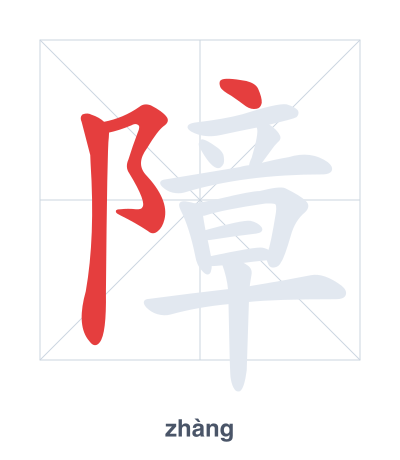
Open Hanzi Writer to see the animated stroke order and practice writing 障 with real-time feedback.
The character 障 (zhàng) is written with 13 strokes. Follow the standard Chinese stroke order: top to bottom, left to right, outside before inside. The radical 阝 is one of its key components.
Practice the correct stroke order with the Hanzi Writer app to see animated stroke-by-stroke guidance with real-time feedback.
障 means barrier; to block.
As an HSK Level 6 character, 障 is an intermediate-level character.
The character 障 combines the radical 阝 (from 阜, meaning a mound or hill) with 章 (zhāng, providing the sound). Together, they depict an earthen mound that serves as a barrier to block passage, reflecting the original meaning of a defensive wall or obstacle.
💡 Memory Tip: Imagine a hill (阝) made of stacked chapters (章) blocking your path like an insurmountable barrier.
路上有很多障碍物。
lù shàng yǒu hěn duō zhàng ài wù
There are many obstacles on the road.
我的电脑出了点故障。
wǒ de diàn nǎo chū le diǎn gù zhàng
Something is wrong with my computer.
大山是天然的屏障。
dà shān shì tiān rán de píng zhàng
The mountain is a natural barrier.
Open Hanzi Writer to see the animated stroke order and practice writing 障 with real-time feedback.
✨ Animated stroke order · Handwriting recognition · HSK-graded practice · Free to use
障 consists of the left radical 阝 (hill/place) and the right component 章 (zhāng). The left part suggests a geographical feature like a hill that blocks movement, while 章 provides phonetic support. Together they form the idea of a ‘barrier’ or something that obstructs.