邙 (máng) means "Mang (referring to Mount Mang)" in Chinese. It has 5 strokes with the radical 阝.
Rated 2.7/5 in difficulty (moderate).
Appears in 3+ common words including 邙山 (máng shān), 北邙 (běi máng), 邙岭 (máng lǐng).
Hanzi Writer's stroke validation shows learners typically need 5-8 attempts to write 邙 with correct proportion and order.
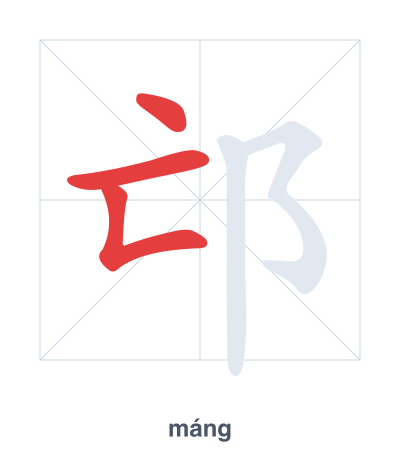
Open Hanzi Writer to see the animated stroke order and practice writing 邙 with real-time feedback.
The character 邙 (máng) is written with 5 strokes. Follow the standard Chinese stroke order: top to bottom, left to right, outside before inside. The radical 阝 is one of its key components.
Practice the correct stroke order with the Hanzi Writer app to see animated stroke-by-stroke guidance with real-time feedback.
邙 means Mang (referring to Mount Mang).
邙 is a compound character: the left radical 阝 (a variant of 阜) means 'hill' or 'mound,' and the right component 亡 (wáng) means 'death' or 'to flee.' Together, they form the name of Mang Mountain near Luoyang, historically a site of imperial tombs, suggesting a 'hill of the dead.'
💡 Memory Tip: Imagine the left ear radical as a grassy hill, and the right part 亡 as a tombstone with a cross (like the top stroke of 亡) marking a burial site on Mount Mang.
邙山在洛阳北边。
máng shān zài luò yáng běi biān
Mount Mang is to the north of Luoyang.
他去过北邙山。
tā qù guò běi máng shān
He has been to Mount Beimang.
邙岭的风景很好。
máng lǐng de fēng jǐng hěn hǎo
The scenery of Mang Ridge is very beautiful.
Open Hanzi Writer to see the animated stroke order and practice writing 邙 with real-time feedback.
✨ Animated stroke order · Handwriting recognition · HSK-graded practice · Free to use
邙 is composed of the radical 阝 (on the left) meaning "hill" or "mound," and the component 亡 on the right which gives the sound máng. Together, they form the name of a specific mountain, Mount Mang, so the radical directly points to a geographic feature.