邛 (qióng) means "Qiong (place name)" in Chinese. It has 5 strokes with the radical 阝.
Rated 2.7/5 in difficulty (moderate).
Appears in 3+ common words including 邛崃 (qióng lái), 邛池 (qióng chí), 邛竹 (qióng zhú).
Hanzi Writer's stroke validation shows learners typically need 5-8 attempts to write 邛 with correct proportion and order.
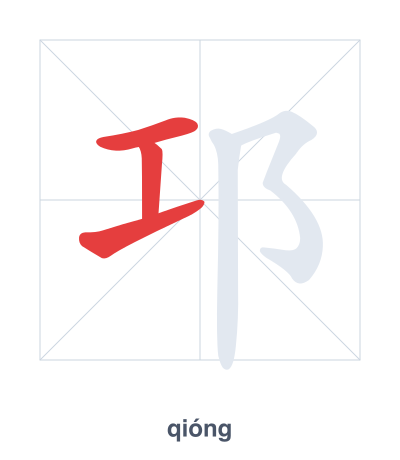
Open Hanzi Writer to see the animated stroke order and practice writing 邛 with real-time feedback.
The character 邛 (qióng) is written with 5 strokes. Follow the standard Chinese stroke order: top to bottom, left to right, outside before inside. The radical 阝 is one of its key components.
Practice the correct stroke order with the Hanzi Writer app to see animated stroke-by-stroke guidance with real-time feedback.
邛 means Qiong (place name).
邛 is a phono-semantic compound where the radical 阝 (left ear) indicates a place or city, while 工 (gōng, meaning 'work') provides the pronunciation. It was the name of an ancient state in present-day Sichuan, as well as a hill in Henan.
💡 Memory Tip: Imagine a worker (工) building a city wall (阝) in a place called Qiong.
邛崃的风景很美。
qióng lái de fēng jǐng hěn měi
The scenery of Qionglai is very beautiful.
邛池的水很深。
qióng chí de shuǐ hěn shēn
The water of Qiong Lake is very deep.
这种竹子叫邛竹。
zhè zhǒng zhú zi jiào qióng zhú
This kind of bamboo is called Qiong bamboo.
Open Hanzi Writer to see the animated stroke order and practice writing 邛 with real-time feedback.
✨ Animated stroke order · Handwriting recognition · HSK-graded practice · Free to use
The character 邛 contains the radical 阝 (left ear), which often indicates a place or hill, and the right part 工 (work or worker). Together, they form a place name, not a literal combination of meanings, so 邛 is used as a proper noun for locations.