故 (gù) means "Reason, old, or deceased" in Chinese. It has 9 strokes with the radical 攵, and is HSK Level 2.
Rated 3.5/5 in difficulty (challenging).
Harder than 63% of HSK Level 2 characters.
Appears in 3+ common words including 故事 (gù shì), 故意 (gù yì), 故乡 (gù xiāng).
Due to its 9 strokes, Hanzi Writer's error detection shows 故 requires focused practice — most learners need 10+ attempts for consistent accuracy.
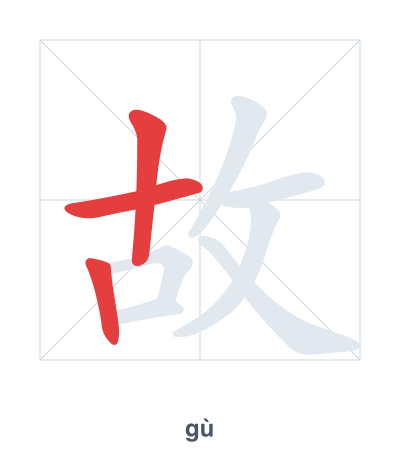
Open Hanzi Writer to see the animated stroke order and practice writing 故 with real-time feedback.
The character 故 (gù) is written with 9 strokes. Follow the standard Chinese stroke order: top to bottom, left to right, outside before inside. The radical 攵 is one of its key components.
Practice the correct stroke order with the Hanzi Writer app to see animated stroke-by-stroke guidance with real-time feedback.
故 means Reason, old, or deceased.
As an HSK Level 2 character, 故 is among the first characters beginners learn.
The character 故 combines 古 (gǔ, 'ancient') on the left, representing something old or past, with 攵 (pū, a hand holding a stick) on the right, which indicates an action or cause. Together, they evoke the idea of 'ancient stories' or 'past actions' that provide a reason or explanation, leading to meanings like 'reason', 'old', or 'deceased'.
💡 Memory Tip: Picture a hand (攵) holding a dusty ancient book (古) to explain the reason why someone is now old and gone.
我喜欢听故事。
wǒ xǐ huān tīng gù shì
I like listening to stories.
他不是故意的。
tā bú shì gù yì de
He didn't do it on purpose.
我的故乡很美。
wǒ de gù xiāng hěn měi
My hometown is beautiful.
Open Hanzi Writer to see the animated stroke order and practice writing 故 with real-time feedback.
✨ Animated stroke order · Handwriting recognition · HSK-graded practice · Free to use
The left part 古 means 'ancient' or 'old,' and the right part 攵 indicates an action. Together, they suggest something from the past that causes a reason or an old event. This explains why 故 can mean 'reason,' 'old,' or 'deceased.'