屏 (bǐng/píng) means "Screen; shield." in Chinese. It has 9 strokes with the radical 尸, and is HSK Level 6.
Rated 4/5 in difficulty (challenging).
Harder than 46% of HSK Level 6 characters.
Appears in 4+ common words including 屏幕 (píng mù), 屏风 (píng fēng), 屏息 (bǐng xī).
Due to its 9 strokes, Hanzi Writer's error detection shows 屏 requires focused practice — most learners need 10+ attempts for consistent accuracy.
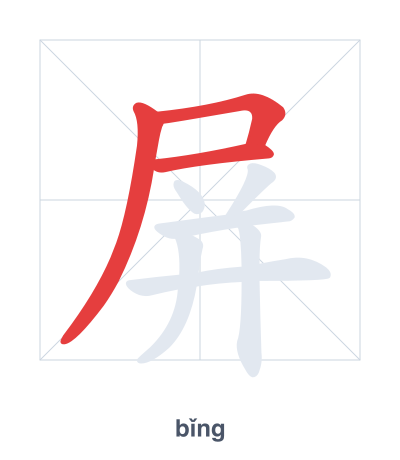
Open Hanzi Writer to see the animated stroke order and practice writing 屏 with real-time feedback.
The character 屏 (bǐng/píng) is written with 9 strokes. Follow the standard Chinese stroke order: top to bottom, left to right, outside before inside. The radical 尸 is one of its key components.
Practice the correct stroke order with the Hanzi Writer app to see animated stroke-by-stroke guidance with real-time feedback.
屏 means Screen; shield..
This is a polyphonic character with readings: bǐng, píng.
As an HSK Level 6 character, 屏 is an intermediate-level character.
The character 屏 combines the radical 尸 (a shelter or covering) with 并 (phonetic, meaning 'to combine' or 'side by side'), originally depicting a screen or partition that blocks view or provides protection. Its ancient form showed a barrier or shield used to screen off a space.
💡 Memory Tip: Picture a screen (屏) made of two panels (并) placed in front of a corpse (尸) to hide it from sight.
长时间盯着电脑屏幕对眼睛不好。
zhǎng shí jiān dīng zhe diàn nǎo píng mù duì yǎn jīng bù hǎo
Staring at a computer screen for a long time is bad for your eyes.
客厅里摆放着一副古色古香的屏风。
kè tīng lǐ bǎi fàng zhe yī fù gǔ sè gǔ xiāng de píng fēng
There is an antique screen in the living room.
全场观众屏息凝神,等待裁判宣布结果。
quán chǎng guān zhòng bǐng xī níng shén děng dài cái pàn xuān bù jié guǒ
The entire audience held their breath, waiting for the referee to announce the result.
我们必须屏除成见,才能精诚合作。
wǒ men bì xū bǐng chú chéng jiàn cái néng jīng chéng hé zuò
We must set aside prejudices to cooperate sincerely.
Open Hanzi Writer to see the animated stroke order and practice writing 屏 with real-time feedback.
✨ Animated stroke order · Handwriting recognition · HSK-graded practice · Free to use
The character 屏 combines the radical 尸 (meaning 'body' or 'house') with the component 并 (meaning 'combine' or 'together'). Together, they suggest a flat, combined structure that blocks or shields, like a screen that hides a person or separates spaces.