邠 (bīn) means "Bin (an ancient place name)." in Chinese. It has 6 strokes with the radical 阝.
Rated 2.9/5 in difficulty (moderate).
Appears in 3+ common words including 邠州 (bīn zhōu), 邠县 (bīn xiàn), 邠风 (bīn fēng).
Hanzi Writer's stroke validation shows learners typically need 5-8 attempts to write 邠 with correct proportion and order.
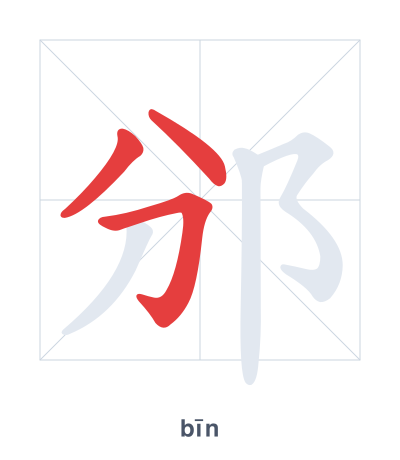
Open Hanzi Writer to see the animated stroke order and practice writing 邠 with real-time feedback.
The character 邠 (bīn) is written with 6 strokes. Follow the standard Chinese stroke order: top to bottom, left to right, outside before inside. The radical 阝 is one of its key components.
Practice the correct stroke order with the Hanzi Writer app to see animated stroke-by-stroke guidance with real-time feedback.
邠 means Bin (an ancient place name)..
邠 combines the radical 阝, meaning a city or settlement, with 分 (fēn, 'to divide')—possibly indicating a border town or a place where land was divided. This character was historically used for an ancient Zhou dynasty state located in present-day Shaanxi province.
💡 Memory Tip: Imagine a city (阝) where a big crack splits the ground (分) right through the middle—that's the ancient place of 邠.
邠州是一个古地名。
bīn zhōu shì yí gè gǔ dì míng
Binzhou is an ancient place name.
他住在邠县。
tā zhù zài bīn xiàn
He lives in Bin County.
这里的邠风很淳朴。
zhè lǐ de bīn fēng hěn chún pǔ
The local customs here are very simple and honest.
Open Hanzi Writer to see the animated stroke order and practice writing 邠 with real-time feedback.
✨ Animated stroke order · Handwriting recognition · HSK-graded practice · Free to use
邠 consists of the left radical 阝 (meaning hill or mound) and the right part 分 (fēn, meaning to divide or distribute). The radical suggests a geographic location, while 分 may indicate a divided region or territory. Together, they form an ancient place name for the Bin region.