邗 (hán) means "Han (ancient place name)" in Chinese. It has 5 strokes with the radical 阝.
Rated 2.7/5 in difficulty (moderate).
Appears in 3+ common words including 邗江 (hán jiāng), 邗沟 (hán gōu), 邗城 (hán chéng).
Hanzi Writer's stroke validation shows learners typically need 5-8 attempts to write 邗 with correct proportion and order.
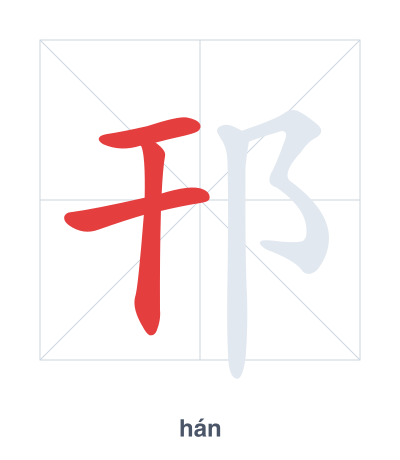
Open Hanzi Writer to see the animated stroke order and practice writing 邗 with real-time feedback.
The character 邗 (hán) is written with 5 strokes. Follow the standard Chinese stroke order: top to bottom, left to right, outside before inside. The radical 阝 is one of its key components.
Practice the correct stroke order with the Hanzi Writer app to see animated stroke-by-stroke guidance with real-time feedback.
邗 means Han (ancient place name).
邗 combines the radical 阝 (city) with 干 (shield). The component 干 gives the pronunciation while the radical indicates a place, together referring to the ancient city-state of Han in present-day Jiangsu.
💡 Memory Tip: Picture a shield (干) leaning against a city wall (阝) at the entrance of the ancient Han state.
邗江在江苏省。
hán jiāng zài jiāng sū shěng
Hanjiang is in Jiangsu Province.
邗沟是一条古运河。
hán gōu shì yī tiáo gǔ yùn hé
The Han Canal is an ancient canal.
邗城历史悠久。
hán chéng lì shǐ yōu jiǔ
Hancheng has a long history.
Open Hanzi Writer to see the animated stroke order and practice writing 邗 with real-time feedback.
✨ Animated stroke order · Handwriting recognition · HSK-graded practice · Free to use
邗 combines the left radical 阝, which means 'place' or 'city', with the right component 干 (gān, meaning 'dry' or 'shield'). The radical gives the meaning of a location, while 干 provides a hint for pronunciation. Together they form the name of an ancient place.