鄄 (juàn) means "Juan (used in place names)" in Chinese. It has 11 strokes with the radical 阝.
Rated 3.9/5 in difficulty (challenging).
Appears in 3+ common words including 鄄城 (juàn chéng), 鄄城县 (juàn chéng xiàn), 鄄邑 (juàn yì).
Due to its 11 strokes, Hanzi Writer's error detection shows 鄄 requires focused practice — most learners need 10+ attempts for consistent accuracy.
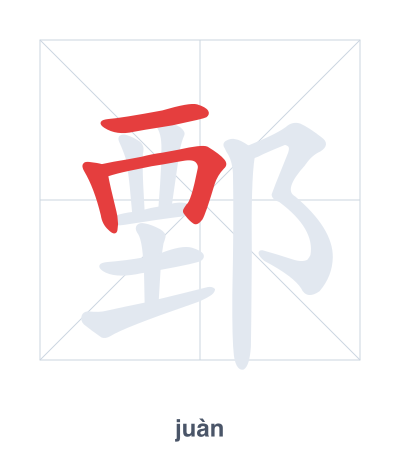
Open Hanzi Writer to see the animated stroke order and practice writing 鄄 with real-time feedback.
The character 鄄 (juàn) is written with 11 strokes. Follow the standard Chinese stroke order: top to bottom, left to right, outside before inside. The radical 阝 is one of its key components.
Practice the correct stroke order with the Hanzi Writer app to see animated stroke-by-stroke guidance with real-time feedback.
鄄 means Juan (used in place names).
鄄 is a phono-semantic compound combining the radical 阝 (city/town) with 耎 (ruǎn) as a phonetic component. It refers to an ancient city in present-day Shandong province, known as Juancheng. The shape shows a town associated with the sound 'ruǎn', but the meaning is purely the place name 'Juan'.
💡 Memory Tip: Picture a person (大) wearing a hat (日) and holding a hand (又) standing in a town (阝) named Juan.
鄄城在山东省。
juàn chéng zài shān dōng shěng
Juancheng is in Shandong Province.
鄄城县有很多特产。
juàn chéng xiàn yǒu hěn duō tè chǎn
Juancheng County has many local specialties.
他老家在鄄城。
tā lǎo jiā zài juàn chéng
His hometown is in Juancheng.
Open Hanzi Writer to see the animated stroke order and practice writing 鄄 with real-time feedback.
✨ Animated stroke order · Handwriting recognition · HSK-graded practice · Free to use
The left radical 阝 (yì) means 'city' or 'place', which indicates that 鄄 is used in place names. The right part is 耎 (ruǎn), which originally meant 'soft' but here serves as a phonetic or decorative component. Together, they form a character that refers to a specific location, like Juancheng County.