邢 (xíng) means "Xing (a surname or place name)." in Chinese. It has 6 strokes with the radical 阝.
Rated 2.9/5 in difficulty (moderate).
Appears in 3+ common words including 邢先生 (xíng xiān shēng), 邢台 (xíng tái), 姓邢 (xìng xíng).
Hanzi Writer's stroke validation shows learners typically need 5-8 attempts to write 邢 with correct proportion and order.
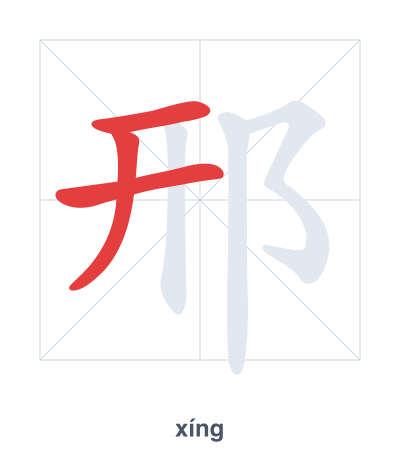
Open Hanzi Writer to see the animated stroke order and practice writing 邢 with real-time feedback.
The character 邢 (xíng) is written with 6 strokes. Follow the standard Chinese stroke order: top to bottom, left to right, outside before inside. The radical 阝 is one of its key components.
Practice the correct stroke order with the Hanzi Writer app to see animated stroke-by-stroke guidance with real-time feedback.
邢 means Xing (a surname or place name)..
邢 is a compound character where the left part 开 (kāi, meaning 'open') provides a phonetic clue, and the right radical 阝 (city mound) indicates a place. It originally referred to an ancient state in present-day Hebei Province, now used as a surname.
💡 Memory Tip: Picture a city (阝) with all its gates wide open (开) — that's the welcoming Xing family hometown.
邢先生是我的老师。
xíng xiān shēng shì wǒ de lǎo shī
Mr. Xing is my teacher.
邢台是一个城市。
xíng tái shì yí gè chéng shì
Xingtai is a city.
我的好朋友姓邢。
wǒ de hǎo péng yǒu xìng xíng
My best friend's surname is Xing.
Open Hanzi Writer to see the animated stroke order and practice writing 邢 with real-time feedback.
✨ Animated stroke order · Handwriting recognition · HSK-graded practice · Free to use
The character 邢 is formed by the left radical 阝 (meaning "hill" or "mound") and the right component 开 (meaning "open" or "begin"). The radical 阝 suggests a place or location, which fits 邢 being a surname and place name. The right part 开 mainly provides the pronunciation xíng, while the overall meaning comes from the radical.