碍 (ài) means "To hinder or obstruct" in Chinese. It has 13 strokes with the radical 石, and is HSK Level 5.
Rated 4.2/5 in difficulty (advanced).
Harder than 84% of HSK Level 5 characters.
Appears in 3+ common words including 障碍 (zhàng ài), 碍事 (ài shì), 妨碍 (fáng ài).
Due to its 13 strokes, Hanzi Writer's error detection shows 碍 requires focused practice — most learners need 10+ attempts for consistent accuracy.
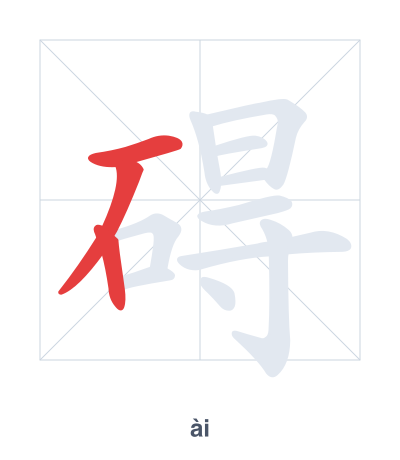
Open Hanzi Writer to see the animated stroke order and practice writing 碍 with real-time feedback.
The character 碍 (ài) is written with 13 strokes. Follow the standard Chinese stroke order: top to bottom, left to right, outside before inside. The radical 石 is one of its key components.
Practice the correct stroke order with the Hanzi Writer app to see animated stroke-by-stroke guidance with real-time feedback.
碍 means To hinder or obstruct.
As an HSK Level 5 character, 碍 is an intermediate-level character.
The character 碍 combines the radical 石 (stone) with 疑 (doubt/hesitation). A stone physically blocks a path, while doubt mentally hinders progress, together representing obstruction.
💡 Memory Tip: Imagine a stone (石) blocking your path, making you doubt (疑) you can get past—that's a hindrance.
路上有很多障碍。
lù shàng yǒu hěn duō zhàng ài
There are many obstacles on the road.
别在这里碍事。
bié zài zhè lǐ ài shì
Don't get in the way here.
请不要妨碍我。
qǐng bú yào fáng ài wǒ
Please don't get in my way.
Open Hanzi Writer to see the animated stroke order and practice writing 碍 with real-time feedback.
✨ Animated stroke order · Handwriting recognition · HSK-graded practice · Free to use
碍 is composed of the radical 石 (stone) on the left and the component 曷 on the right. The stone radical suggests hardness or obstruction, while 曷 contributes phonetic sound. Together they depict something solid that blocks movement.