邘 (yú) means "Yu (ancient state name / surname)" in Chinese. It has 5 strokes with the radical 阝.
Rated 2.7/5 in difficulty (moderate).
Appears in 3+ common words including 邘国 (yú guó), 邘城 (yú chéng), 邘姓 (yú xìng).
Hanzi Writer's stroke validation shows learners typically need 5-8 attempts to write 邘 with correct proportion and order.
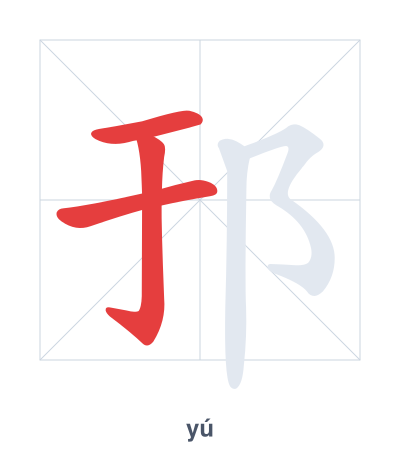
Open Hanzi Writer to see the animated stroke order and practice writing 邘 with real-time feedback.
The character 邘 (yú) is written with 5 strokes. Follow the standard Chinese stroke order: top to bottom, left to right, outside before inside. The radical 阝 is one of its key components.
Practice the correct stroke order with the Hanzi Writer app to see animated stroke-by-stroke guidance with real-time feedback.
邘 means Yu (ancient state name / surname).
邘 is a phono-semantic compound where the left radical 阝 (a variant of 阜, meaning 'mound' or 'place') indicates a location, and the right component 于 (yú) provides the pronunciation. It originally referred to an ancient state or place name, likely situated near a hill or elevated area.
💡 Memory Tip: Imagine a hill (阝) shaped like a hook (于) marking the ancient territory of the Yu state.
邘国是一个古国。
yú guó shì yí gè gǔ guó
The State of Yu was an ancient state.
邘城遗址在这里。
yú chéng yí zhǐ zài zhè lǐ
The ruins of Yucheng are here.
他姓邘。
tā xìng yú
His surname is Yu.
Open Hanzi Writer to see the animated stroke order and practice writing 邘 with real-time feedback.
✨ Animated stroke order · Handwriting recognition · HSK-graded practice · Free to use
邘 is made of the radical 阝 (meaning "city" or "place") on the left and 于 (yú, meaning "at" or "in") on the right. The 阝 radical indicates a place or city, so 邘 originally referred to an ancient state or city named Yu.