言 (yán) means "speech; words; to speak" in Chinese. It has 7 strokes with the radical 言, and is HSK Level 2.
Rated 2.7/5 in difficulty (moderate).
Harder than 31% of HSK Level 2 characters.
Appears in 3+ common words including 语言 (yǔ yán), 发言 (fā yán), 方言 (fāng yán).
Hanzi Writer's stroke validation shows learners typically need 5-8 attempts to write 言 with correct proportion and order.
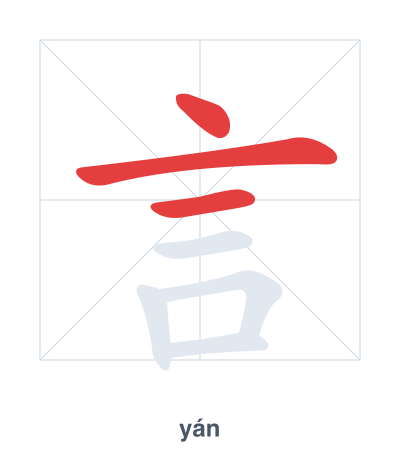
Open Hanzi Writer to see the animated stroke order and practice writing 言 with real-time feedback.
The character 言 (yán) is written with 7 strokes. Follow the standard Chinese stroke order: top to bottom, left to right, outside before inside. The radical 言 is one of its key components.
Practice the correct stroke order with the Hanzi Writer app to see animated stroke-by-stroke guidance with real-time feedback.
言 means speech; words; to speak.
As an HSK Level 2 character, 言 is among the first characters beginners learn.
言 is a pictograph of a mouth (口) with a tongue or sound waves emerging upward. In ancient oracle bone script, it showed a mouth with a forked tongue extending forward, representing the act of speaking. Later forms simplified this into a mouth below and a horizontal line with three strokes above, symbolizing words or sounds coming out.
💡 Memory Tip: Imagine a podium (the top lines) with a mouth (口) beneath it, delivering three points of a speech.
我学习语言。
wǒ xué xí yǔ yán
I'm learning languages.
请大家发言。
qǐng dà jiā fā yán
Everyone, please speak up.
他说广东方言。
tā shuō guǎng dōng fāng yán
He speaks Cantonese.
Open Hanzi Writer to see the animated stroke order and practice writing 言 with real-time feedback.
✨ Animated stroke order · Handwriting recognition · HSK-graded practice · Free to use
言 is made of two main parts: the top part (亠) represents a lid or a speech bubble, and the bottom part (口) represents a mouth. Together, they show words coming out of a mouth, which connects to the meaning of 'speech' or 'to speak'.