恨 (hèn) means "to hate" in Chinese. It has 9 strokes with the radical 忄, and is HSK Level 5.
Rated 4/5 in difficulty (challenging).
Harder than 49% of HSK Level 5 characters.
Appears in 3+ common words including 痛恨 (tòng hèn), 恨不得 (hèn bù dé), 记恨 (jì hèn).
Due to its 9 strokes, Hanzi Writer's error detection shows 恨 requires focused practice — most learners need 10+ attempts for consistent accuracy.
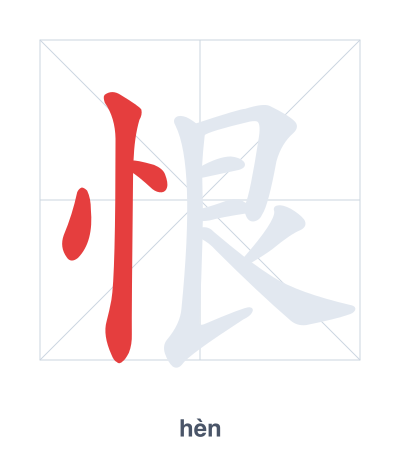
Open Hanzi Writer to see the animated stroke order and practice writing 恨 with real-time feedback.
The character 恨 (hèn) is written with 9 strokes. Follow the standard Chinese stroke order: top to bottom, left to right, outside before inside. The radical 忄 is one of its key components.
Practice the correct stroke order with the Hanzi Writer app to see animated stroke-by-stroke guidance with real-time feedback.
恨 means to hate.
As an HSK Level 5 character, 恨 is an intermediate-level character.
The character 恨 combines the heart radical 忄 (indicating emotion) with 艮 (gèn), a phonetic component that originally depicted a person turning their back, suggesting the emotional turning away or rejection central to hatred.
💡 Memory Tip: Picture a heart (忄) pierced by a thorny branch (the right side 艮)—the pain of hate feels like a thorn stuck deep in your chest.
我痛恨说谎的人。
wǒ tòng hèn shuō huǎng de rén
I detest people who lie.
我恨不得马上回家。
wǒ hèn bù dé mǎ shàng huí jiā
I can't wait to go home right away.
他从不记恨别人。
tā cóng bù jì hèn bié rén
He never bears a grudge against others.
Open Hanzi Writer to see the animated stroke order and practice writing 恨 with real-time feedback.
✨ Animated stroke order · Handwriting recognition · HSK-graded practice · Free to use
恨 is made of two parts: the left radical 忄 (heart) and the right component 艮 (gèn). The heart radical shows this character is about an emotion, while 艮 gives the pronunciation and suggests something hard or stubborn. Together they create the feeling of a heart holding stubborn anger — that is hate.