遇 (yù) means "to meet; to encounter" in Chinese. It has 12 strokes with the radical 辶, and is HSK Level 4.
Rated 4.2/5 in difficulty (advanced).
Harder than 96% of HSK Level 4 characters.
Appears in 3+ common words including 遇见 (yù jiàn), 遇到 (yù dào), 待遇 (dài yù).
Due to its 12 strokes, Hanzi Writer's error detection shows 遇 requires focused practice — most learners need 10+ attempts for consistent accuracy.
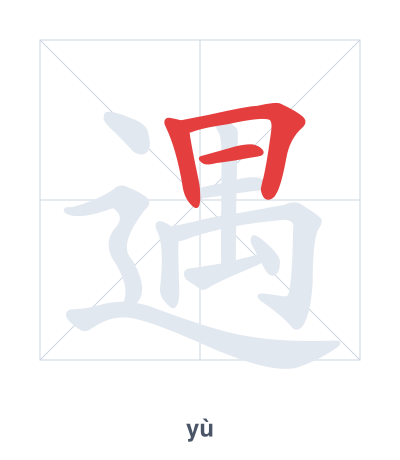
Open Hanzi Writer to see the animated stroke order and practice writing 遇 with real-time feedback.
The character 遇 (yù) is written with 12 strokes. Follow the standard Chinese stroke order: top to bottom, left to right, outside before inside. The radical 辶 is one of its key components.
Practice the correct stroke order with the Hanzi Writer app to see animated stroke-by-stroke guidance with real-time feedback.
遇 means to meet; to encounter.
As an HSK Level 4 character, 遇 is an intermediate-level character.
遇 combines the radical 辶 (walking) with the phonetic component 禺, which depicted a mythical creature. The character suggests an encounter that happens while moving or traveling, as if meeting someone or something unexpected on the road.
💡 Memory Tip: Picture yourself walking (辶) and suddenly bumping into a strange creature (禺) — that's your unexpected meeting.
我在街上遇见了他。
wǒ zài jiē shàng yù jiàn le tā
I met him on the street.
遇到困难别放弃。
yù dào kùn nán bié fàng qì
Don't give up when you encounter difficulties.
这家公司待遇很好。
zhè jiā gōng sī dài yù hěn hǎo
This company offers good benefits.
Open Hanzi Writer to see the animated stroke order and practice writing 遇 with real-time feedback.
✨ Animated stroke order · Handwriting recognition · HSK-graded practice · Free to use
遇 consists of the radical 辶 (walking) on the left and the phonetic component 禺 on the right. The radical suggests movement or a path, while 禺 provides the sound "yu." Together they create the idea of encountering someone or something while moving.