待 (dāi/dài) means "to wait; to treat" in Chinese. It has 9 strokes with the radical 彳, and is HSK Level 3.
Rated 4/5 in difficulty (challenging).
Harder than 61% of HSK Level 3 characters.
Appears in 4+ common words including 等待 (děng dài), 接待 (jiē dài), 对待 (duì dài).
Due to its 9 strokes, Hanzi Writer's error detection shows 待 requires focused practice — most learners need 10+ attempts for consistent accuracy.
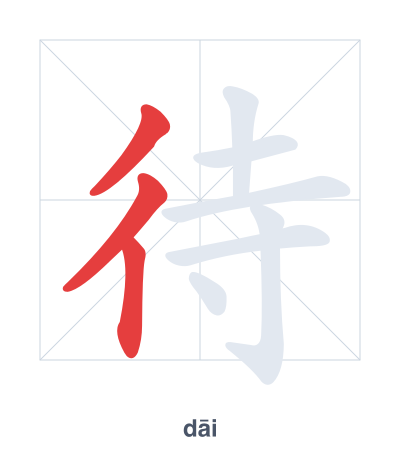
Open Hanzi Writer to see the animated stroke order and practice writing 待 with real-time feedback.
The character 待 (dāi/dài) is written with 9 strokes. Follow the standard Chinese stroke order: top to bottom, left to right, outside before inside. The radical 彳 is one of its key components.
Practice the correct stroke order with the Hanzi Writer app to see animated stroke-by-stroke guidance with real-time feedback.
待 means to wait; to treat.
This is a polyphonic character with readings: dāi, dài.
As an HSK Level 3 character, 待 is an intermediate-level character.
The character 待 combines the radical 彳 (a step or small street) indicating movement or action with 寺 (temple) as a phonetic component. Together they evoke the idea of pausing or stopping by a temple, which leads to the meanings of 'to wait' or 'to treat (a guest).'
💡 Memory Tip: Picture a traveler (彳) stopping at a temple (寺) to wait and be treated to a meal.
请在门口耐心等待。
qǐng zài mén kǒu nài xīn děng dài
Please wait patiently at the door.
他负责接待外国游客。
tā fù zé jiē dài wài guó yóu kè
He is responsible for receiving foreign tourists.
我们要友好对待邻居。
wǒ men yào yǒu hǎo duì dài lín jū
We should treat our neighbors kindly.
你先待会儿,我马上就来。
nǐ xiān dāi huìr, wǒ mǎ shàng jiù lái
Wait a moment, I'll be right there.
Open Hanzi Writer to see the animated stroke order and practice writing 待 with real-time feedback.
✨ Animated stroke order · Handwriting recognition · HSK-graded practice · Free to use
待 is composed of the radical 彳 (chi4, meaning 'step' or 'small street') on the left and the character 寺 (si4, meaning 'temple') on the right. The 彳 radical suggests movement or action, while 寺 provides a phonetic hint for the pronunciation dāi. Together, they imply staying in one place (like at a temple) to wait for something or to treat someone.