误 (wù) means "mistake" in Chinese. It has 9 strokes with the radical 讠, and is HSK Level 3.
Rated 3.7/5 in difficulty (challenging).
Harder than 55% of HSK Level 3 characters.
Appears in 3+ common words including 错误 (cuò wù), 误会 (wù huì), 耽误 (dān wù).
Due to its 9 strokes, Hanzi Writer's error detection shows 误 requires focused practice — most learners need 10+ attempts for consistent accuracy.
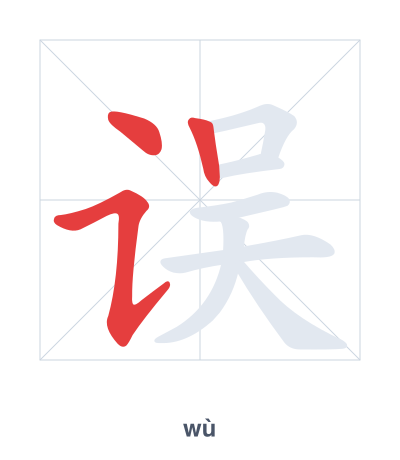
Open Hanzi Writer to see the animated stroke order and practice writing 误 with real-time feedback.
The character 误 (wù) is written with 9 strokes. Follow the standard Chinese stroke order: top to bottom, left to right, outside before inside. The radical 讠 is one of its key components.
Practice the correct stroke order with the Hanzi Writer app to see animated stroke-by-stroke guidance with real-time feedback.
误 means mistake.
As an HSK Level 3 character, 误 is an intermediate-level character.
误 is a phono-semantic compound combining the radical 讠 (speech/words) with the phonetic component 吴 (wú). Originally it meant to deceive or mislead through speech, and later extended to any mistake or error.
💡 Memory Tip: Picture a person named Wu (吴) speaking (讠) confidently but getting everything wrong — that's a huge mistake.
这个答案是错误的。
zhè ge dá àn shì cuò wù de
This answer is incorrect.
这是一个误会。
zhè shì yí gè wù huì
This is a misunderstanding.
别耽误大家的时间。
bié dān wù dà jiā de shí jiān
Don't waste everyone's time.
Open Hanzi Writer to see the animated stroke order and practice writing 误 with real-time feedback.
✨ Animated stroke order · Handwriting recognition · HSK-graded practice · Free to use
The character 误 has two parts: the left radical 讠 (speech) and the right part 吴 (wú). The speech radical indicates that the meaning involves words or language, and 吴 provides the pronunciation. Together they convey the idea of a mistake in speech or thought, which is the core meaning of "mistake."