Hanzi Writer

How to Write 错 (cuò) — Meaning “Wrong / mistake”

cuò HSK Level 1 13 strokes Radical: 钅

错 (cuò) means "Wrong / mistake" in Chinese. It has 13 strokes with the radical 钅, and is HSK Level 1.

Rated 3.7/5 in difficulty (challenging).

Harder than 99% of HSK Level 1 characters.

Appears in 3+ common words including 不错 (bù cuò), 错误 (cuò wù), 错过 (cuò guò).

Due to its 13 strokes, Hanzi Writer's error detection shows 错 requires focused practice — most learners need 10+ attempts for consistent accuracy.
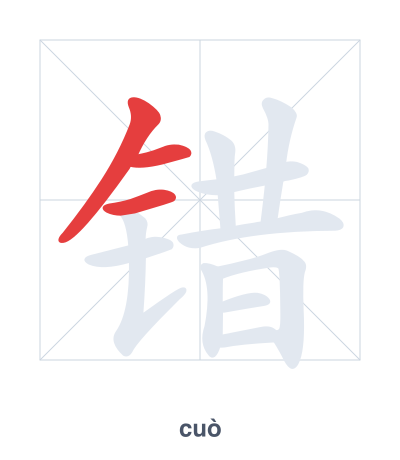
Stroke order practice for 错 - cuò

Practice Writing 错 (cuò)

Open Hanzi Writer to see the animated stroke order and practice writing 错 with real-time feedback.

The character (cuò) is written with 13 strokes. Follow the standard Chinese stroke order: top to bottom, left to right, outside before inside. The radical is one of its key components.

Practice the correct stroke order with the Hanzi Writer app to see animated stroke-by-stroke guidance with real-time feedback.

means Wrong / mistake.

As an HSK Level 1 character, is among the first characters beginners learn.

Character
Pinyincuò (cuo)
MeaningWrong / mistake
Strokes13
Radical
HSK Level1
Difficulty3.7/5

The character 错 combines the radical 钅 (metal/gold) with 昔 (past/old), originally meaning 'to inlay with gold' or 'to grind/polish metal.' Over time, it was borrowed phonetically to mean 'wrong' or 'mistake,' as if a costly golden error from the past.

💡 Memory Tip: Imagine a golden (钅) statue from the past (昔) that was made with a huge mistake—it's a 错 (wrong) investment.

bù cuò
Not bad / Correct
cuò wù
Error / Mistake
cuò guò
To miss (an opportunity)

你的汉语不错。

nǐ de hàn yǔ bù cuò

Your Chinese is quite good.

这是个错误。

zhè shì gè cuò wù

This is a mistake.

我错过了公共汽车。

wǒ cuò guò le gōng gòng qì chē

I missed the bus.

Character Pinyin Strokes Radical
(current) cuò 13
kào 11
lǎo 11
ěr 11
Stroke order practice for 错 - cuò

Practice Writing 错 (cuò)

Open Hanzi Writer to see the animated stroke order and practice writing 错 with real-time feedback.

✨ Animated stroke order · Handwriting recognition · HSK-graded practice · Free to use

Frequently Asked Questions about 错

错 is made of the radical 钅 (metal) on the left and the component 昔 (meaning 'former times' or 'old') on the right. The metal radical gives a hint that the character originally related to inlaid metalwork, but over time the meaning shifted to 'wrong' or 'mistake,' perhaps because a mismatch or error in inlaying is seen as a 'wrong' placement. The right side 昔 adds a phonetic clue and can remind you that a mistake often involves something from the past that is no longer correct.

More HSK Level 1 Characters

Characters with Radical 钅

Other 13-Stroke Characters