耽 (dān) means "delay; indulge in" in Chinese. It has 10 strokes with the radical 耳, and is HSK Level 7.
Rated 4.2/5 in difficulty (advanced).
Harder than 82% of HSK Level 7 characters.
Appears in 3+ common words including 耽误 (dān wù), 耽搁 (dān gē), 耽于 (dān yú).
Due to its 10 strokes, Hanzi Writer's error detection shows 耽 requires focused practice — most learners need 10+ attempts for consistent accuracy.
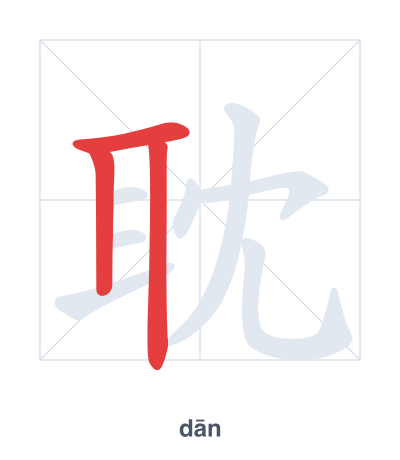
Open Hanzi Writer to see the animated stroke order and practice writing 耽 with real-time feedback.
The character 耽 (dān) is written with 10 strokes. Follow the standard Chinese stroke order: top to bottom, left to right, outside before inside. The radical 耳 is one of its key components.
Practice the correct stroke order with the Hanzi Writer app to see animated stroke-by-stroke guidance with real-time feedback.
耽 means delay; indulge in.
As an HSK Level 7 character, 耽 is an intermediate-level character.
The character 耽 combines the radical 耳 (ear) with the component 冘 (a phonetic meaning 'to go forward'), suggesting the idea of being so absorbed in listening that one lingers or delays. This evolved to mean 'indulge in' pleasures, especially sensual ones, and by extension 'delay.'
💡 Memory Tip: Picture your ear (耳) glued to a loudspeaker, making you delay everything because you're indulging in the music.
别耽误了学习。
bié dān wù le xué xí
Don't neglect your studies.
路上耽搁了十分钟。
lù shàng dān gē le shí fēn zhōng
I was delayed for ten minutes on the way.
他耽于幻想。
tā dān yú huàn xiǎng
He indulges in fantasies.
Open Hanzi Writer to see the animated stroke order and practice writing 耽 with real-time feedback.
✨ Animated stroke order · Handwriting recognition · HSK-graded practice · Free to use
The character 耽 consists of the radical 耳 (ear) on the left and the component 冘 on the right. The ear suggests listening intently, and 冘 originally depicted a person carrying a burden, implying being weighed down or absorbed. Together they convey the idea of being so focused on something (like listening) that you delay other tasks or indulge excessively.