诂 (gǔ) means "To explain / To gloss (archaic words)" in Chinese. It has 7 strokes with the radical 讠.
Rated 3.2/5 in difficulty (challenging).
Appears in 3+ common words including 训诂 (xùn gǔ), 诂训 (gǔ xùn), 解诂 (jiě gǔ).
Due to its 7 strokes, Hanzi Writer's error detection shows 诂 requires focused practice — most learners need 10+ attempts for consistent accuracy.
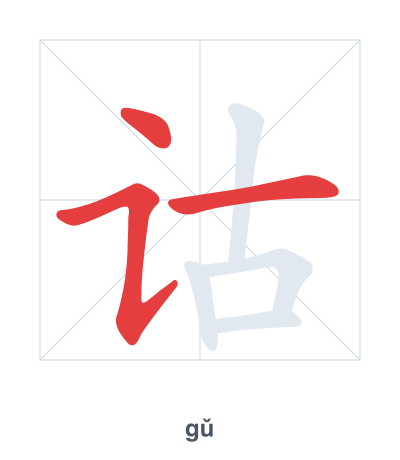
Open Hanzi Writer to see the animated stroke order and practice writing 诂 with real-time feedback.
The character 诂 (gǔ) is written with 7 strokes. Follow the standard Chinese stroke order: top to bottom, left to right, outside before inside. The radical 讠 is one of its key components.
Practice the correct stroke order with the Hanzi Writer app to see animated stroke-by-stroke guidance with real-time feedback.
诂 means To explain / To gloss (archaic words).
诂 is a compound character formed from the radical 讠 (speech) on the left and the phonetic component 古 (gǔ, meaning 'ancient') on the right. Together, they convey the idea of 'speaking about ancient things'—that is, explaining or glossing archaic words.
💡 Memory Tip: Picture a scholar standing at a podium (讠) holding a dusty scroll with the symbol 古 (old) on it, lecturing students on the meanings of ancient terms.
他在研究训诂学。
tā zài yán jiū xùn gǔ xué
He is studying exegesis and historical linguistics.
这本书有详细的诂训。
zhè běn shū yǒu xiáng xì de gǔ xùn
This book has detailed glosses.
这篇解诂很清楚。
zhè piān jiě gǔ hěn qīng chǔ
This commentary is very clear.
Open Hanzi Writer to see the animated stroke order and practice writing 诂 with real-time feedback.
✨ Animated stroke order · Handwriting recognition · HSK-graded practice · Free to use
The character 诂 uses the radical 讠 (speech) on the left and the component 古 (old/ancient) on the right. This structure suggests "speech about ancient things," which matches its meaning of explaining archaic words.